Last Tuesday, a lively Labrador from Balham arrived at our clinic with a persistent limp that standard X-rays simply couldn’t explain. We see many dedicated owners in Streatham and Clapham who find themselves in this exact position, feeling a mix of uncertainty and worry when a routine check-up doesn’t yield a clear answer. It’s completely normal to feel apprehensive about moving towards advanced imaging, particularly when you’re balancing concerns about anaesthesia safety with the need for a definitive diagnosis.
Our clinical team at Streatham Hill Veterinary Surgery is here to provide clarity on exactly when does a dog need a CT scan to ensure the best possible outcome for their health. By reading this guide, you’ll learn why we recommend 3D imaging over traditional X-rays and how our independent veterinary surgery uses these detailed insights to build precise surgical plans. We’ll walk you through the entire process, from managing procedural risks to understanding how a clearer picture leads to a much faster recovery for your beloved companion.
Key Takeaways
- Discover how 3D computed tomography provides a 360-degree view of your pet’s internal health, revealing vital details that standard X-rays often cannot see.
- Identify the specific clinical signs, such as persistent nasal discharge or complex middle ear issues, that help our team determine when does a dog need a CT scan.
- Learn what to expect during the seamless referral process to Advanced Vetcare London (AVL), including why gentle anaesthesia is essential for a precise, motion-free diagnosis.
- Understand how advanced imaging allows our surgeons to plan the most effective path forward, often making the difference between traditional surgery and minimally invasive keyhole procedures.
- Gain peace of mind by exploring how we coordinate every step of your dog’s diagnostic journey, ensuring Streatham and Balham owners receive specialist-level insights with local, compassionate care.
Understanding Veterinary CT Scans: Beyond the Standard X-Ray
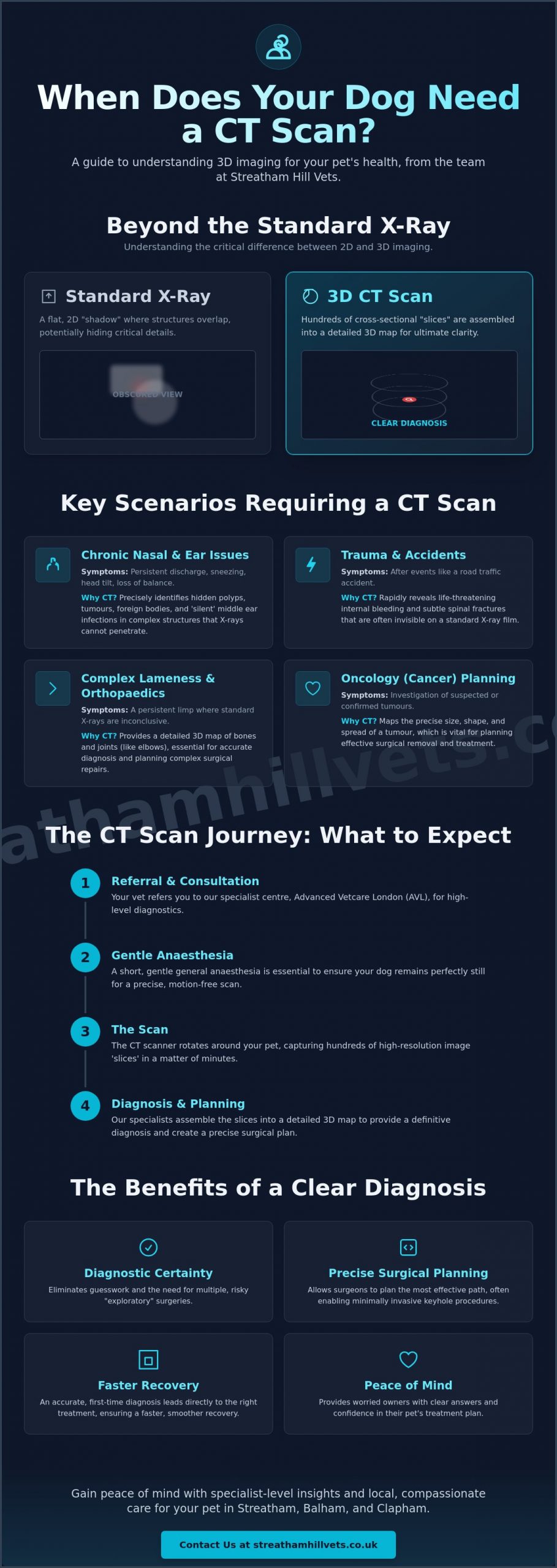
We often find that pet owners are familiar with standard X-rays, but Computed Tomography (CT) offers a level of depth that traditional imaging simply cannot match. To understand what a CT scan is, think of it as a 360-degree, three-dimensional X-ray. Instead of a single flat image, the scanner rotates around your dog, capturing hundreds of individual “slices” of the body. Our team then assembles these slices into a detailed 3D map, allowing us to examine internal structures from every possible angle.
The primary advantage of this technology is its cross-sectional capability. Traditional X-rays are useful, but they essentially provide a “shadow” where bones and organs overlap, sometimes hiding small but critical details. In our experience, identifying precisely when does a dog need a CT scan often depends on whether we need to see “inside” or “behind” a dense structure. At our South London clinics, we use this advanced imaging to look through overlapping tissues, ensuring nothing is missed in complex areas like the joints, chest, or abdomen.
For dogs in Streatham and Balham, CT scanning has become a vital tool for managing urban trauma and chronic health conditions. Whether a pet has been involved in a road traffic accident or is suffering from a long-term, unexplained cough, the clarity provided by 3D imaging is often the key to a successful recovery. We provide these high-level diagnostics through our dedicated referral centre, Advanced Vetcare London (AVL), ensuring your companion has access to hospital-grade technology right here in the local community.
CT vs. X-ray and Ultrasound: Which is Best?
Each diagnostic tool has its place in a modern veterinary hospital. We typically prefer ultrasound when we need to observe soft tissue movement in real-time, such as the rhythmic beating of a heart or the flow of blood. However, ultrasound cannot penetrate bone or air-filled spaces. This makes CT the gold standard for “hidden” areas, particularly the nasal cavity, the lungs, and the complex structures of the inner ear. By providing a complete 3D map, CT allows our surgical teams to plan procedures with millimetre precision, which is rarely possible with 2D imaging alone.
Why Precision Matters for London Pets
In a busy 24-hour hospital environment, a rapid and accurate diagnosis can be life-saving. We understand that waiting for answers is the hardest part for any pet owner. Using 3D imaging provides “diagnostic certainty,” which significantly reduces the need for multiple “exploratory” surgeries that carry higher risks and longer recovery times. For the anxious owners we support in Clapham and Balham, this precision means we can move straight to the most effective treatment plan. It’s about providing peace of mind through clinical excellence, ensuring your dog receives the exact care they need without unnecessary delay.
Common Scenarios Where Your Dog May Require a CT Scan
Determining when does a dog need a CT scan usually comes down to the level of detail required for a safe, accurate diagnosis. In our South London clinics, we often see cases where traditional radiography simply cannot provide the 3D perspective needed to plan a complex procedure. For instance, if your pet is involved in a road traffic accident in Streatham or Clapham, we use advanced imaging at our hospital to quickly identify internal haemorrhaging or subtle spinal fractures that might be missed on a standard film. Our priority is always to provide clarity for you and the best possible outcome for your companion.
Investigating Chronic Nasal and Ear Issues
Nasal issues are a common frustration for many owners. If your dog has a persistent discharge or sneezing that doesn’t clear with antibiotics, a CT scan is the gold standard for finding the cause. The complex, honeycomb-like structures of the nasal turbinates are far too intricate for standard X-rays, which often only show a blurry grey image. A scan reveals hidden polyps, tumours, or even stubborn grass seeds that have migrated deep into the cavity. The CT process for pets involves a short period of general anaesthesia, ensuring your dog stays perfectly still while we capture high-resolution slices. This precision is equally vital for diagnosing ‘silent’ middle ear infections, which often present as a persistent head tilt or loss of balance.
Surgical Planning for Orthopaedics and Oncology
When we deal with complex lameness, particularly in the elbow or shoulder joints, a CT scan allows us to map the bone and cartilage in three dimensions. This level of detail is vital for planning the placement of plates and screws in multi-fragment fractures. In oncology cases, we use CT to look for the ‘roots’ of a tumour and check if the cancer has spread to the lungs or other organs. Knowing exactly where the margins are helps our surgeons achieve a cleaner result during the operation. This diagnostic depth often guides our keyhole surgery options, which offer a faster, more comfortable recovery for your pet. If you are worried about a new lump or a persistent limp, you can find more information about our CT scanning services and how they might benefit your dog’s specific case.
We are here to support pet owners across Streatham, Balham, and Clapham with the highest level of diagnostic care. If you feel your dog’s symptoms require a deeper look, our team is ready to help you understand if and when does a dog need a CT scan to move forward with their treatment plan.
What to Expect: The CT Process at Advanced Vetcare London (AVL)
When we determine that your companion requires advanced imaging, we make the transition from our Streatham clinic to our sister hospital, Advanced Vetcare London (AVL), as seamless as possible. Our teams work in close partnership, sharing medical records and diagnostic notes instantly so you don’t have to repeat your pet’s history. This collaborative approach ensures that your dog receives the highest level of care without the stress of navigating a fragmented referral system.
Ensuring that diagnostic data is shared securely and efficiently is a cornerstone of modern veterinary care. For businesses in any industry looking to improve their own digital workflows and communication tools, check out HJS Technology Ltd.
The process is designed to be efficient and thorough. Most pets arrive in the morning and are ready to return home later the same day. Our clinicians at AVL are experts in handling complex cases, and they maintain the same empathetic, local feel you’ve come to expect from our Streatham Hill practice. We focus on providing clarity during what can be a worrying time for any pet owner.
Why is Anaesthesia Necessary for a CT?
A primary concern for many owners is the use of general anaesthesia or heavy sedation. Unlike a human who can be told to hold their breath and stay still, a dog cannot remain perfectly motionless for the duration of the scan. Even the tiny movements from normal breathing can cause “motion blur” on the images, potentially masking subtle details. To capture high-resolution 3D slices, your pet must be completely still.
We use modern anaesthetic protocols that are specifically tailored to the individual pet, including senior dogs or those with pre-existing conditions. Our dedicated nursing team provides continuous, one-on-one monitoring throughout the entire procedure. In our experience, this level of focused care significantly reduces risks and ensures a smooth recovery. This precision is vital when considering when does a dog need a CT scan for delicate areas like the spine or brain.
The Role of Contrast and Specialist Interpretation
To get the most out of the technology, we often perform “contrast studies.” This involves injecting a safe, liquid dye that makes specific tissues “pop” on the screen. It’s an essential tool for highlighting blood vessels and identifying the exact margins of tumours. Before we administer any contrast agent, we always perform blood tests to check your dog’s kidney values, ensuring they can process the dye safely and effectively.
The value of a CT scan lies not just in the images themselves, but in how they are read. According to the American College of Veterinary Radiology, CT is a superior diagnostic tool for complex internal structures. At AVL, every scan is reviewed by a specialist veterinary radiologist. These experts have years of additional training to spot minute abnormalities that might be missed by the naked eye. Having a specialist interpret the data ensures that your pet’s treatment plan is based on the most accurate information possible.
If you have concerns about your pet’s health or want to discuss whether advanced imaging is the right step, you can book a consultation online with our experienced team in Streatham.
Planning Your Pet’s Care: Costs, Results, and Next Steps
Once the scan is complete, the process moves swiftly to ensure your pet receives the right treatment without delay. In our experience, while the initial images are reviewed immediately by our clinical team, a comprehensive specialist report from a board-certified radiologist usually takes between 24 and 48 hours. This detailed analysis is vital; it allows us to pinpoint the exact location of an issue, which is often the deciding factor in how we proceed with treatment.
The data we gather from a CT scan is far more detailed than a standard X-ray. It provides a 3D map that helps our surgeons decide between traditional open surgery and minimally invasive keyhole surgery. By knowing the exact margins of a tumour or the precise path of a foreign object, we can reduce surgical time and improve the recovery outlook for your companion. Understanding when does a dog need a CT scan is often about choosing the most direct and least invasive path to health.
Navigating Costs and Insurance
We recognise that advanced imaging is a significant financial consideration for many families. Most pet insurance providers cover these scans under ‘advanced diagnostics,’ though we always recommend checking your policy limits before proceeding. To help make this level of care more accessible to our South London neighbours, members of our VIP Health Plan benefit from a 10% discount on all fees, including diagnostic imaging. For unexpected procedures, we also provide 0% finance options to help manage the costs of your pet’s journey back to health without added stress.
From Diagnosis to Recovery
The findings from the scan lead directly into a bespoke hospitalisation plan. We’ll sit down with you for a follow-up consultation to explain the 3D findings in plain English, ensuring you feel confident in the next steps. Whether your dog needs specialist surgery at Advanced Vetcare London (AVL) or medical management at our Streatham practice, our team is here to support you at every stage.
Being an independent, multi-award-winning practice means we prioritise the bond between you and your pet above all else. We are here 24/7 for our community in Streatham, Clapham, and Balham, providing the reassurance of expert care whenever it’s needed most. If you’re concerned about your pet’s health or have been advised that they may require advanced imaging, please reach out to our team for clear, compassionate guidance.
Ensuring Clarity for Your Pet’s Health
Advanced diagnostics represent a significant step in your pet’s healthcare journey. While traditional X-rays remain a vital tool, a CT scan offers the intricate detail necessary for diagnosing complex conditions in the chest, abdomen, or joints. Having this level of precision allows us to create targeted treatment plans that focus on your dog’s long-term comfort and recovery. We understand that the prospect of advanced imaging can feel daunting, but it’s often the quickest route to the answers you and your companion deserve.
Our clinical team is here to guide you through the process and help you understand exactly when does a dog need a CT scan to move their care forward. As a multi-award-winning independent practice, we provide a seamless link to specialist imaging at Advanced Vetcare London (AVL), alongside our 24-hour emergency care available 365 days a year. We’re committed to supporting the Streatham, Balham, and Clapham communities with professional expertise and genuine local warmth. If you’re concerned about your pet’s health or have been advised that imaging may be necessary, we’re ready to help.
Book a consultation at Streatham Hill Vets to discuss your pet’s diagnostic needs and let’s work together to keep your beloved friend happy and healthy.
Frequently Asked Questions
Is a CT scan safe for an older dog?
Age isn’t a disease, so a CT scan is generally safe for senior dogs provided we’ve performed a thorough clinical assessment first. Before any procedure at our Streatham practice, we’ll carry out blood tests to check kidney and liver function, ensuring your older companion can safely handle the sedation or general anaesthetic required. In our experience, the diagnostic benefits of knowing when does a dog need a CT scan far outweigh the minimal risks, as it allows us to detect age-related issues like tumours or spinal changes early.
How long does a dog CT scan actually take?
The actual scanning process is remarkably quick, often taking less than 5 minutes to capture thousands of high-resolution images. However, you should plan for your pet to be with us for a few hours. This time allows our team at Advanced Vetcare London to safely induce anaesthesia, position your dog perfectly for the images, and monitor their recovery until they’re fully awake. We’ll always call you as soon as they’re sitting up and ready for a post-scan cuddle.
Does my dog have to stay overnight for a CT scan?
Most dogs don’t need to stay overnight and can return home the same afternoon. Since the procedure is non-invasive, your pet will simply need time for the anaesthetic to wear off under the watchful eye of our 24-hour nursing team. If the scan is part of an emergency admission or if your dog requires immediate surgery based on the findings, our Streatham Hill hospital is fully equipped for overnight hospitalisation to ensure they receive continuous care.
Can my dog have a CT scan without anaesthesia?
No, dogs require a general anaesthetic or heavy sedation to ensure they remain perfectly still during the procedure. Even the slightest movement can blur the images, making them impossible for our specialists to interpret accurately. We use modern, tailored anaesthetic protocols to keep your pet safe and comfortable throughout. Understanding when does a dog need a CT scan involves accepting that a short period of sleep is necessary to get the clear, life-saving answers we need for your pet’s health.
What is the difference between a CT scan and an MRI for a dog?
A CT scan uses X-rays to create detailed 3D images of bones, lungs, and blood vessels, whereas an MRI uses magnetic fields to look at soft tissues like the brain and spinal cord. CT scans are significantly faster than MRIs, making them the preferred choice for checking for internal bleeding or lung disease in a busy clinical setting. Our team will recommend the most appropriate modality based on whether we’re investigating a complex fracture or a neurological concern in your dog.
How much does a dog CT scan cost in South London?
The cost of a CT scan varies based on the number of body areas we need to image and whether your dog requires intravenous contrast to highlight specific organs. In the South London area, fees are influenced by the requirement for specialist radiologist reporting and the advanced technology used at our referral centre. We’ll always provide a detailed, written breakdown of costs during your consultation. Our Pet Health Club members also benefit from a 10% discount on all diagnostic imaging at our clinics.