Last Tuesday evening, a local family arrived at our Streatham surgery in a state of total shock after their young Labrador darted into the path of a car on the busy South Circular. It’s a scenario we see all too often in our practice, where the suddenness of a road traffic accident leaves even the most composed owners feeling completely helpless and overwhelmed. We understand that in those first few minutes, your mind is flooded with panic and questions about whether your companion will pull through or what hidden damage might be occurring internally.
This guide provides a clear, clinical look at the dog hit by car survival rate uk statistics, helping you understand the realistic outcomes based on our years of emergency experience in South London. Our goal is to replace that initial fear with a structured plan of action and the reassurance you need during a crisis. We’ll walk you through the vital steps to take at the scene, the importance of rapid diagnostic imaging, and how our dedicated 24-hour emergency team supports pets from Clapham to Balham when every second counts. In our experience, having a calm, professional roadmap is the first step toward the best possible recovery for your pet.
Key Takeaways
- Learn about the dog hit by car survival rate uk, including clinical research suggesting that roughly three-quarters of dogs survive road traffic accidents with prompt veterinary intervention.
- Understand the critical factors that influence a positive outcome, from the severity of the initial impact to the speed of the vehicle on our busy South London roads.
- Discover the essential safety steps to take at the scene in areas like Balham or Clapham to protect yourself while providing calm, immediate assistance to your pet.
- Gain insight into our 24/7 emergency triage and stabilisation process, which prioritises pain management and shock treatment to improve recovery prospects.
- Find out how our independent team at Streatham Hill Vets uses advanced diagnostics and expert care to support South London families through every stage of an emergency.
Understanding Dog Hit by Car Survival Rates in the UK
Seeing your dog involved in a road traffic accident (RTA) is every owner’s worst nightmare. While the immediate shock is overwhelming, understanding the actual dog hit by car survival rate uk statistics can provide a much-needed sense of perspective during a crisis. In our experience at Streatham Hill Vets, the moments following an accident are critical, but the data offers more hope than many owners realize.
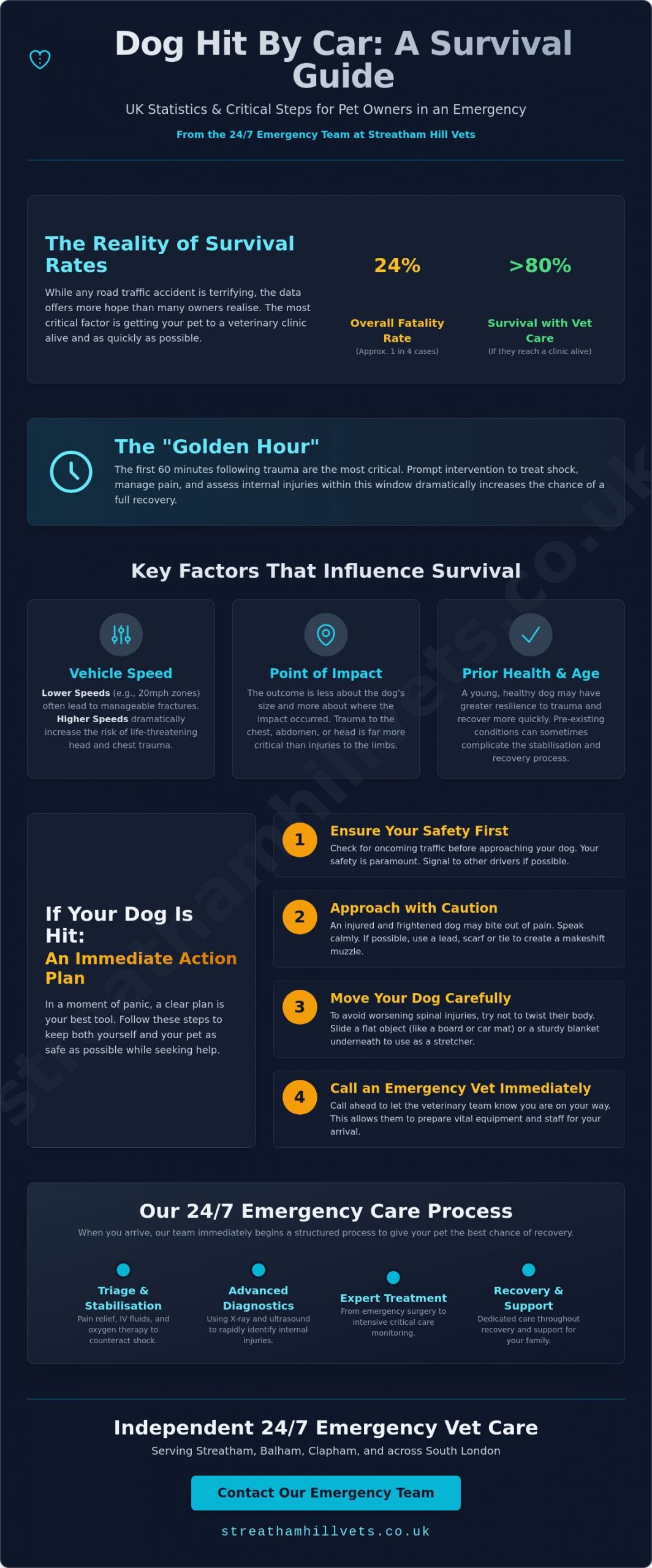
Research from the Royal Veterinary College (RVC) VetCompass programme indicates that approximately 24.2%, or roughly 1 in 4 RTA cases, result in a fatality. While Roadkill statistics often focus on wildlife, the data for domestic pets in urban areas shows a distinct pattern of injury. There is a crucial distinction to be made here: if a dog reaches a veterinary clinic alive, the survival rate jumps significantly to over 80%. This highlights why immediate transit to an emergency 24-hour vetcare facility is the single most important factor in a positive outcome.
The nature of injuries we see in South London often differs from those in rural settings. On country lanes, higher speeds frequently lead to more catastrophic, high-impact trauma. In contrast, the urban environment of Streatham and Clapham often involves lower-speed “shunts” or glancing blows, which, while still serious, carry a higher probability of successful treatment and recovery.
Why London Dogs Face Unique RTA Risks
Living in South London presents specific challenges for our canine companions. High-traffic arteries like the A23 and the South Circular are constant sources of danger, especially during peak commuting hours. Even the most well-trained dog can have their “street-smart” behaviour overridden by an unpredictable trigger. We frequently see cases where a dog has bolted across a road after spotting one of the many bold South London foxes that frequent our gardens and parks.
Fortunately, the prevalence of 20mph speed limits in residential areas like Streatham Hill and Balham plays a vital role in survival. A lower impact speed directly correlates with less severe internal trauma and fewer complex fractures. While the congestion of London is often a frustration, in the context of an RTA, slower-moving traffic is a significant factor in why so many of the pets brought to us eventually return home to their families.
The Reality of Survival: What the Data Tells Us
The “Golden Hour” in veterinary emergency medicine refers to the first sixty minutes following a traumatic injury when prompt clinical intervention is most likely to prevent death or permanent organ damage. Our data shows a direct statistical correlation between dogs that receive intensive 24-hour care within this window and those that make a full recovery. Early stabilisation, pain management, and fluid therapy are essential to counteract the effects of shock.
There are several common misconceptions regarding which dogs are most likely to survive an accident. Many owners believe that larger breeds are more resilient, but survival is rarely determined by size or breed alone. Instead, the outcome depends on the point of impact and the speed of the vehicle. Whether you own a tiny terrier or a large retriever, the dog hit by car survival rate uk remains high if the animal is treated for internal injuries and shock before they become irreversible. We treat every pet as an individual, focusing on rapid diagnostics to give them the best possible chance of recovery.
Critical Factors that Influence Survival After a Road Accident
Survival isn’t determined by a single factor, but rather a combination of the impact’s physics and the speed of veterinary intervention. In our South London clinics, we find that the speed of the vehicle and the point of contact are the most immediate predictors of an outcome. A low-speed collision in a 20mph residential zone in Streatham may result in manageable limb fractures; however, an accident on a faster A-road often involves life-threatening chest or head trauma. According to a UK study on dog road traffic accidents, approximately 22.9% of dogs involved in these incidents did not survive, which underscores the serious nature of these emergencies. This data highlights why the dog hit by car survival rate uk is so dependent on rapid, expert assessment in the “golden hour” following the event.
The dog’s age and overall health play a significant role in their ability to recover from shock. Younger, fitter dogs often have better cardiovascular reserves, but they are equally susceptible to the devastating effects of a pneumothorax (collapsed lung) or severe internal haemorrhage. We also consider the road surface; South London’s tarmac can cause significant friction burns or “road rash.” While these may look superficial, they require intensive wound management to prevent infection while we simultaneously treat more pressing internal concerns.
The Danger of Hidden Internal Injuries
Adrenaline is a powerful biological mask. We frequently see dogs walk into our surgery after a collision looking remarkably stable, only to collapse moments later as the initial shock wears off. This “fight or flight” response hides the pain of a ruptured spleen or a diaphragmatic hernia, where abdominal organs are pushed into the chest cavity. Because of this, we insist on a minimum of 24 to 48 hours of professional clinical observation. During this window, our team monitors for delayed signs of internal bleeding or neurological decline that aren’t always apparent during the first few minutes at the scene.
How Advanced Diagnostics Save Lives in Streatham
Standard X-rays are useful for identifying broken bones, but they have limitations when dealing with complex multi-organ trauma. At Streatham Hill Vets, we utilise advanced CT scanning to gain a detailed three-dimensional view of the patient. This technology allows us to identify tiny bleeds, subtle skull fractures, or lung contusions that traditional imaging might miss. For the most complex cases requiring specialist emergency surgery, our relationship with Advanced Vetcare London (AVL) ensures your pet has access to a dedicated referral hospital environment. If you’re concerned about your pet’s health following even a minor bump, it’s always safer to book a health check to ensure no hidden issues are present.
What to Do if Your Dog is Hit by a Car in South London
The moments following a road traffic accident are often the most critical for your dog’s recovery. In busy South London areas like Balham or Clapham, the immediate environment can be chaotic and dangerous. Your first priority must be your own safety. Ensure traffic has stopped or move to a safe pavement before attending to your pet. We often see owners put themselves at risk in the heat of the moment, but you cannot help your pet if you are also injured.
When you approach, do so with extreme caution. Even the gentlest family companion can bite instinctively when they are in significant pain or respiratory distress. Speak in a low, soothing voice and avoid sudden movements. Quickly assess for basic life signs by observing the rise and fall of the chest for breathing and checking for a pulse inside the upper thigh. Pet owners frequently ask us about the official Office for National Statistics data regarding the dog hit by car survival rate uk. Interestingly, there are no official government figures collected on these incidents. However, in our clinical experience at Streatham Hill Vets, rapid intervention is the single most influential factor in a positive outcome.
On-Scene First Aid and Safety
If your dog is conscious and trying to snap, a makeshift muzzle using a soft lead or a pair of tights can prevent injuries. Never muzzle a dog that is vomiting or struggling to breathe. If you see active external bleeding, apply gentle, firm pressure with a clean cloth or bandage. We strongly advise that you don’t offer any food or water. If your dog is in shock or requires emergency surgery upon arrival, having an empty stomach is vital for a safe anaesthetic. Contact us immediately so our team can prepare the oxygen and diagnostics before you arrive.
Safe Transport to Our Streatham Surgery
Moving an injured animal requires care to prevent worsening internal injuries or spinal damage. If possible, use a flat board, a sturdy piece of cardboard, or even a heavy coat as a makeshift stretcher to keep the spine as still as possible. Clinical shock often causes a drop in body temperature, so wrap your dog in blankets to maintain warmth during the journey. If you’re in a taxi or have a friend driving, direct them straight to our 24-hour emergency facility in Streatham. Our team is always on-site, meaning we don’t waste precious minutes waiting for a vet to travel from home. This immediate access to care is why the dog hit by car survival rate uk can be significantly improved with prompt action.
Emergency Care and Recovery at Streatham Hill Vets
When you arrive at our Streatham surgery following an accident, our 24/7 triage process begins the second you walk through the door. We understand that these moments are incredibly distressing for pet owners. Our clinical team immediately performs a primary survey to assess your dog’s airway, breathing, and circulation. This rapid assessment allows us to prioritise life-saving interventions such as oxygen therapy or intravenous fluid resuscitation to combat shock.
Stabilisation is our first priority. We focus on aggressive pain management and internal medicine to ensure your pet is comfortable before moving on to more complex diagnostics. While the dog hit by car survival rate uk is generally high for pets who reach a vet alive, the first 60 minutes are often the most critical for long-term outcomes. We work calmly and methodically to manage internal bleeding and head trauma, keeping you informed at every stage of the process. We also provide clear, transparent communication regarding costs and can assist with direct insurance claims to help ease the financial burden during an emergency.
Hospitalisation and Intensive Care
Recovery from a road traffic accident (RTA) requires more than just initial surgery; it requires constant vigilance. Our hospitalisation services provide a safe, quiet environment where your pet is monitored by qualified veterinary nurses throughout the night. We use advanced monitoring equipment to track heart rates, blood pressure, and oxygen levels around the clock. This level of intensive care is vital for managing complex surgical recoveries and ensuring that pain relief is adjusted in real-time as your pet’s needs change.
Long-term Support for London Residents
The journey to full health often continues long after your pet leaves our hospital wards. We provide comprehensive follow-up care, including physiotherapy and specialist health checks, to ensure your dog regains their mobility and quality of life. For our local community, our VIP Health Plan offers a practical way to manage ongoing preventative care, providing discounts on medications and check-ups that support a smooth recovery.
We are proud to be an independent practice serving our neighbours across South London. If you are a pet owner in Streatham, Clapham, or Balham and find yourself in an emergency, please remember that our doors are always open. We treat every animal as if they were our own, combining clinical excellence with the gentle, compassionate care your family deserves.
Prioritising Your Pet’s Recovery and Long-Term Wellbeing
While the moments following a road accident are undoubtedly distressing, the outlook for your companion is often more positive than you might first fear. Rapid intervention remains the single most important factor in a successful outcome. In our clinical experience, pets that receive a professional assessment within the first hour have significantly better prospects. We’ve seen how advanced diagnostics, such as our on-site CT scanning, allow us to identify internal injuries that aren’t visible to the naked eye. This precision ensures we can begin the correct treatment immediately.
Understanding the dog hit by car survival rate uk helps South London owners make informed decisions when every second counts. As an independent, multi-award-winning practice, we’re here to provide the clinical expertise and gentle care your family deserves. Whether you’re in Streatham, Clapham, or Balham, you don’t have to face these emergencies alone. Our team treats every pet as an individual, focusing on both medical excellence and your peace of mind.
If your pet has been involved in an accident, please contact our 24-hour emergency team in Streatham immediately. Our doors are open 365 days a year to ensure your pet receives the highest standard of care when they need it most. We’re dedicated to helping your dog return to their happy, healthy self.
Frequently Asked Questions
Is a dog hit by a car likely to survive if there is no visible blood?
A dog can still have life-threatening injuries even if there’s no visible blood on their coat or the pavement. In our clinical experience at Streatham Hill Vets, internal trauma such as a ruptured spleen or pulmonary contusions often presents without any external wounds. We use rapid diagnostic tools like ultrasound to identify these hidden issues, as the dog hit by car survival rate uk depends heavily on the early detection of internal bleeding.
How much does it cost to treat a dog hit by a car at an emergency vet in London?
Emergency veterinary costs in London typically begin with an out-of-hours consultation fee, which often ranges from £150 to £250 depending on the time of night. For complex cases requiring intensive stabilization, advanced imaging, and surgery, total costs can reach between £2,000 and £5,000. These figures reflect the specialist monitoring, life-saving medications, and sophisticated equipment required to manage critical trauma in a high-cost metropolitan area.
Should I take my dog to the vet even if they seem fine after a minor bump?
You should always seek a veterinary assessment after any road traffic accident, regardless of how your pet appears initially. Adrenaline often masks severe pain and symptoms of shock in the immediate aftermath of a collision. Our team in South London frequently sees pets who seem bright and mobile at the scene but deteriorate rapidly hours later due to delayed onset internal issues or rising intracranial pressure.
What are the most common life-threatening injuries in UK road accidents?
The most frequent life-threatening injuries we treat include pneumothorax, diaphragmatic hernias, and severe internal haemorrhage. Statistics from the Royal Veterinary College indicate that thoracic trauma occurs in approximately 20% of dogs involved in road traffic accidents. These conditions require immediate clinical intervention and often involve our 24-hour emergency team providing oxygen therapy or emergency surgery to improve the dog hit by car survival rate uk.
Can I claim the vet fees from the driver’s insurance in the UK?
You can potentially claim vet fees from a driver’s insurance if it’s proven they were negligent or at fault for the accident. Under the Road Traffic Act 1988, drivers must stop and report accidents involving dogs to the police. However, if the dog was off its lead and ran into the path of a vehicle, the owner might be held liable for any damage to the car instead. For drivers who need to address vehicle damage or ensure their car remains safe on the road, you can learn more about Thurton Auto Centre. We always recommend checking your own pet insurance policy first to cover immediate emergency costs.
How long does a dog usually stay in hospital after being hit by a car?
Most dogs require a hospital stay of 24 to 72 hours for initial stabilization and close monitoring of their vital signs. If your companion needs complex orthopaedic surgery or has suffered neurological trauma, they may stay with us for a week or longer. Our independent practice provides round-the-clock care, ensuring your pet is never left alone during their recovery period in our dedicated Streatham wards.