
It’s 11:00 PM on a Tuesday evening in Streatham, and your usually vibrant companion is suddenly pacing restlessly, unable to settle or find a comfortable position. We understand that specific, cold spike of anxiety that hits when you realise something is wrong but aren’t quite certain if it’s a life-threatening crisis. It’s an incredibly heavy burden to carry, particularly when you’re weighing up medical uncertainty against the stress of navigating South London traffic in the middle of the night.
In our experience at Streatham Hill Vets, we’ve found that having a clear plan can be the difference between panic and purposeful action. This guide will show you exactly how to know if my dog needs a vet immediately by breaking down the critical “Red Flag” symptoms that require urgent clinical attention. We’ll provide you with definitive “go or stay” criteria and a structured 60-minute plan to help you manage the situation with confidence. By understanding these life-saving markers, you can ensure your beloved family member receives our expert, 24-hour emergency care the moment they need it most.
Key Takeaways
- Learn to identify life-threatening ‘Red Flag’ symptoms and understand why the veterinary ‘Golden Hour’ is critical for your dog’s recovery.
- Discover exactly how to know if my dog needs a vet immediately by learning how to assess vital signs in just sixty seconds.
- Differentiate between minor upsets and urgent medical ‘Grey Areas’ that require professional intervention, such as persistent vomiting or haemorrhagic symptoms.
- Master the immediate steps for safely transporting an injured or unconscious pet to our Streatham Hill surgery from Balham, Clapham, or Brixton.
- Understand the clinical advantages of our independent status and how our 24/7 on-site hospitalisation provides seamless continuity of care for your beloved companion.
Recognizing the Absolute ‘Red Flags’: When Every Minute Counts for Your Dog
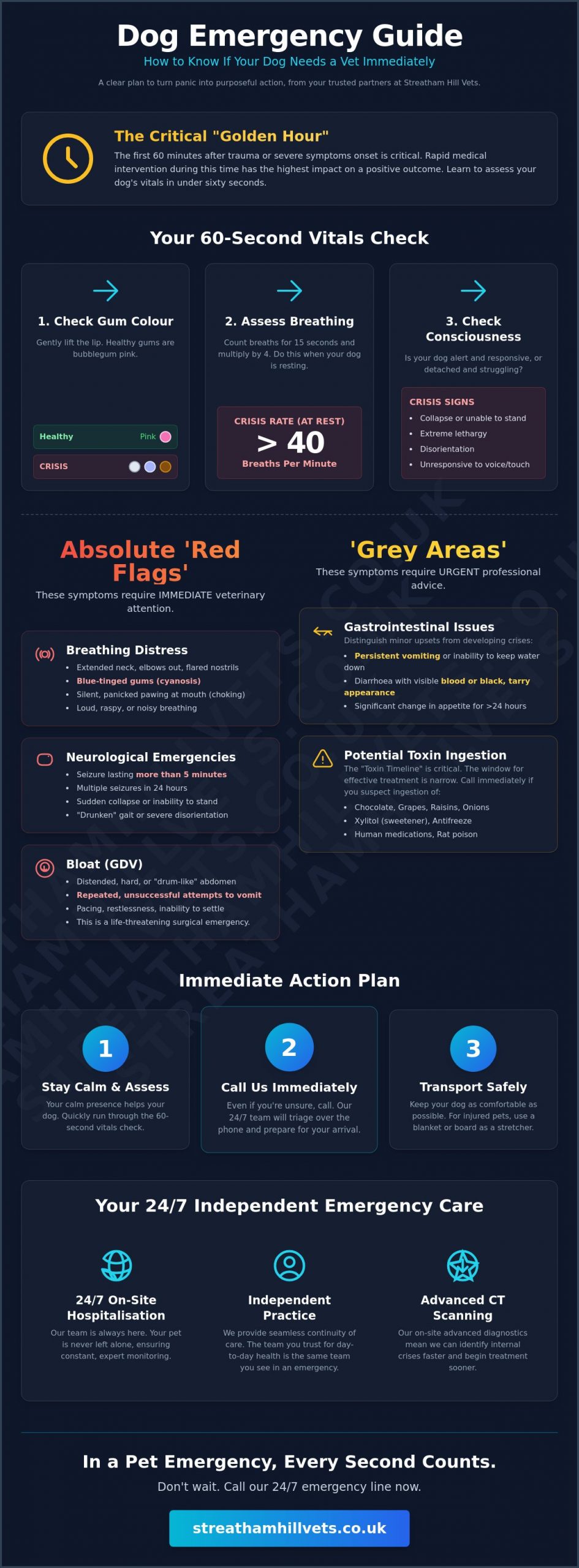
In our Streatham practice, we often speak with owners about the “Golden Hour.” This clinical concept refers to the first sixty minutes following a trauma or the sudden onset of severe symptoms. During this window, rapid medical intervention has the highest statistical impact on a positive outcome. Understanding how to know if my dog needs a vet immediately often comes down to a quick assessment of their ABCs: Airway, Breathing, and Circulation. While some symptoms can wait for a scheduled appointment, red-flag indicators suggest a life-threatening crisis that requires an instant call to our emergency 24-hour vetcare line.
You can assess your dog’s basic vitals in under sixty seconds. Check their gum colour; they should be a healthy bubblegum pink. Feel for a heartbeat behind the left elbow and count the breaths per minute. A resting rate over forty breaths per minute, or gums that appear pale, white, or muddy, indicates a crisis rather than a minor concern. While a foundational knowledge of Pet First Aid is incredibly useful for stabilising a patient, it should never replace or delay professional triage. If your dog is struggling to stand or seems detached from their surroundings, we need to see them straight away.
Critical Breathing Difficulties and Respiratory Distress
True respiratory distress, often called “air hunger,” is a primary emergency. Your dog may extend their neck, flare their nostrils, or stand with elbows turned out to expand their chest. If you see blue-tinged gums, known as cyanosis, this signals a critical lack of oxygen. We frequently see flat-faced (brachycephalic) breeds from Clapham and Balham, such as French Bulldogs or Pugs, who are at a significantly higher risk of heat-related obstructive crises. It is vital to distinguish between a “reverse sneeze,” which is a loud, rhythmic snort that usually passes, and actual choking. A choking dog will often be silent, pawing at their mouth, or displaying a panicked expression with blue or pale membranes.
Neurological Emergencies: Seizures, Collapse, and Disorientation
Witnessing a seizure is distressing, but your priority is keeping the environment safe. Don’t put your hands near your dog’s mouth as they may bite involuntarily. Clear away hard furniture and dim the lights. A single seizure lasting more than five minutes, or multiple seizures in a 24-hour period, is a neurological emergency. We also treat many cases of Gastric Dilatation-Volvulus (GDV), or “Bloat,” which is a surgical emergency. If your dog has a distended, hard abdomen and is repeatedly trying to vomit with no success, every second is vital. Similarly, sudden hind-limb paralysis or a “drunken” gait can indicate severe spinal issues. Our independent practice utilizes the advanced diagnostic power of our CT scanning facilities to quickly identify these internal crises and begin treatment.
Understanding the ‘Grey Areas’: Symptoms That Require Urgent Veterinary Attention
Sometimes, the signs that a dog is unwell are subtle, making it difficult for owners to determine the level of urgency. Understanding how to know if my dog needs a vet immediately often involves distinguishing between a minor upset and a developing crisis. In our experience at Streatham Hill Vets, we find that “grey area” symptoms, such as a change in appetite or a slight limp, can occasionally mask more serious underlying issues that require professional intervention.
Gastrointestinal issues are a frequent cause for concern. A one-off bout of vomiting after your dog has scavenged something in the garden is often just a simple upset. However, if the vomiting is persistent, or if your dog cannot keep water down, this suggests a potential obstruction or severe metabolic illness. Similarly, while mild diarrhoea is common, haemorrhagic diarrhoea is a different matter entirely. If you notice blood in the stool, or if it resembles dark, tarry coffee grounds, it indicates significant internal inflammation or bleeding. We recommend checking this guide on when to seek emergency care to help you gauge the severity of these symptoms.
The “Toxin Timeline” is another critical factor. If your dog eats chocolate, grapes, or raisins, the window for effective treatment is narrow. These substances can cause everything from heart arrhythmias to sudden kidney failure. We often aim to induce vomiting within two hours of ingestion to prevent the toxins from entering the bloodstream. Waiting for symptoms to appear is often too late, as internal damage may already be underway.
Recognising pain in dogs is challenging because they are biologically programmed to hide vulnerability. You might notice subtle cues like trembling, a reluctance to move, or an arched back. Understanding how to know if my dog needs a vet immediately means looking for these quiet shifts in behaviour. If your dog is suddenly panting while at rest or hiding in unusual places, they are likely experiencing significant discomfort.
Gastrointestinal Distress and the Threat of Obstruction
During a walk in Tooting Common, it’s remarkably easy for a dog to swallow a stone, a fragment of a tennis ball, or a thick stick. These items can become lodged in the digestive tract, leading to a life-threatening blockage. A hallmark sign of a true emergency is “unproductive retching,” where your dog appears to be trying to vomit but nothing comes up. This is a primary indicator of Gastric Torsion, or Bloat, where the stomach twists on itself. You can perform a quick dehydration check at home by using the skin-tent test. Gently pinch the skin between the shoulder blades; if it doesn’t snap back instantly, or if their gums feel tacky and dry, they need immediate fluid therapy.
Eye Injuries and Sudden Behavioural Changes
We treat every eye injury as an urgent priority because the ocular surface is incredibly fragile. A dog that is squinting, pawing at its face, or has a cloudy appearance to the eye could have a corneal ulcer that can worsen within hours. Behavioural shifts are equally telling. If a typically friendly dog shows sudden aggression, or if you notice extreme lethargy where they won’t stand for a treat, the brain or central nervous system may be under stress. Acute pain is a clinical emergency requiring immediate triage. If you are worried about your companion, our emergency 24-hour vetcare team is always here to provide the support and expertise you need.
Immediate Action Plan: Navigating a Pet Emergency in South London
When you’ve determined your pet requires urgent care, the next ten minutes are critical. We understand the panic that sets in during these moments. Staying calm is your most important tool, as your dog will mirror your emotional state. In our experience, a focused owner helps us provide faster, more effective care. If you are still wondering how to know if my dog needs a vet immediately, remember that any sudden change in breathing, consciousness, or ability to walk is a definitive signal to start your journey to our surgery.
Safe Transport and On-Site Triage
Moving a dog in pain requires careful handling to prevent further injury to the pet and potential bites to the owner. For large dogs, we recommend using a makeshift stretcher. A heavy blanket, a large towel, or even a sturdy coat can be used to keep the spine neutral and the body supported. Always approach an injured dog slowly; even the gentlest companion may snap when they are in significant pain. If you have a small dog or a puppy, a secure carrier or a cardboard box lined with towels is the safest option.
It’s vital that you call us while you are on your way. This allows our clinical team to prepare the oxygen, fluid therapy, and crash-cart before you even pull into the car park. When you arrive, we perform an immediate triage. This is a clinical assessment where we determine the urgency of your dog’s condition. While we aim to see everyone quickly, the most life-threatening cases must take priority in our treatment area.
Emergency Logistics in Streatham and Surrounding Areas
Our independent surgery is ideally located to serve our neighbors across South London. If you’re traveling from Balham or Clapham, the A24 and A214 usually provide the most direct access. For those coming from Brixton, the A23 is the primary route. We provide dedicated parking directly at the front of the Streatham Hill Veterinary Surgery to ensure you can get your dog into the building without delay. If your dog is too heavy to carry alone, please alert our reception team upon arrival and we will assist you with a stretcher.
There are several common first aid myths that can complicate a clinical situation. Please avoid the following before you reach us:
- Never give human painkillers: Drugs like paracetamol or ibuprofen are highly toxic to dogs and can cause organ failure.
- Don’t induce vomiting: Unless specifically instructed by one of our vets, do not use salt water or other home remedies to make your dog sick, as this can lead to salt poisoning or aspiration.
- Avoid “wait and see”: If you are questioning how to know if my dog needs a vet immediately, the safest answer is always to seek a professional assessment.
Our team is here to provide clinical excellence and empathetic support during these high-pressure moments. We treat every pet as if they were our own, ensuring they receive the highest standard of care in a modern, well-equipped environment.
If your pet is experiencing an emergency right now, please contact our 24-hour emergency vetcare team immediately for advice and assistance.
Streatham Hill Vets: 24/7 Independent Emergency Care for South London
When you’re searching for how to know if my dog needs a vet immediately, you need more than just a list of symptoms; you need a team ready to act the moment you arrive. As an independent practice, our clinical decisions are made by the veterinary surgeons on the floor, not by a corporate board in a distant office. This freedom allows us to prioritise your pet’s specific medical needs above all else, ensuring that the care we provide is as unique as the bond you share with your companion.
Our hospital operates 24 hours a day, 365 days a year, providing a level of continuity that’s rare in modern veterinary medicine. We don’t believe in the stress of transporting a critically ill animal to a different facility for overnight care. Instead, our award-winning team remains on-site, providing a seamless transition from emergency triage to intensive recovery within the same familiar walls.
For complex cases, we provide access to advanced diagnostics including CT and MRI through our referral hospital, Advanced Vetcare London (AVL). This integration means we can investigate internal injuries or neurological concerns with incredible precision, often saving vital time during a crisis.
Continuous Care: From Emergency Triage to Recovery
Our dedicated night team monitors our most vulnerable patients throughout the early hours, ensuring that no change in condition goes unnoticed. In our experience, we often see that the first few hours after an emergency are the most critical. Having a skilled team on hand to adjust treatments in real-time is what defines our approach to intensive care.
We’re also equipped to perform advanced surgical interventions when every second counts. This includes keyhole surgery and laparoscopic options for emergency stabilisation. These minimally invasive techniques result in smaller incisions and faster recovery times, which is particularly beneficial for dogs who’ve already been through a traumatic event.
Peace of Mind for Streatham, Clapham, and Balham Residents
We understand that emergency visits are high-stress situations. Our team is committed to clear, honest communication, helping you understand how to know if my dog needs a vet immediately in the future while supporting you through the current challenge. We treat every pet like a member of our own family, combining clinical authority with the empathy you’d expect from a trusted neighbour.
To help manage the long-term health of your pet and provide financial predictability, many of our local clients utilise our VIP Health Plan. While this covers essential preventative care like vaccinations and parasite protection, it also offers a 10% discount on many other services, providing an extra layer of support for your household budget.
Whether you’re in Streatham, Clapham, or Balham, our doors are always open. We’re here to offer the professional help and reassurance you need, ensuring your pet receives the highest standard of emergency medicine in South London.
Protecting Your Companion Around the Clock
Deciding how to know if my dog needs a vet immediately often comes down to a combination of observing clear red flags and trusting your own intuition as an owner. If your dog is struggling to breathe, has collapsed, or shows signs of severe abdominal pain, these are non-negotiable emergencies that require instant intervention. In our experience at the clinic, it’s always better to seek professional advice early rather than waiting to see if symptoms improve overnight. Quick action is often the most vital factor in a successful clinical outcome.
As a multi-award-winning independent practice, we’re proud to provide a dedicated on-site 24/7 emergency team and full hospitalisation facilities right here in South London. We don’t outsource our out-of-hours care; your pet stays in a familiar environment with access to advanced CT and MRI diagnostics via our referral hospital, AVL. Whether you’re in Streatham, Clapham, or Balham, our team is ready to provide the sophisticated, compassionate care your beloved family member deserves at any hour of the day or night.
If you’re worried about your pet, please don’t hesitate. Contact our 24-Hour Emergency Team immediately if you are worried about your pet. We’re here to support you and your companion through every step of the journey.
Frequently Asked Questions
How do I know if my dog is in enough pain to be an emergency?
Dogs are experts at masking discomfort, so you should look for physiological signs rather than waiting for whimpering or crying. In our experience, acute pain often manifests as heavy panting, a hunched back, or a resting heart rate that stays above 100 beats per minute. If your companion is restless, trembling, or guarding a specific part of their body, it’s a clear indicator of how to know if my dog needs a vet immediately. We recommend seeking a professional assessment at our Streatham clinic to ensure your pet isn’t suffering in silence.
Can I wait until the morning if my dog has been vomiting but seems okay otherwise?
A single episode of sickness might not be urgent, but repeated vomiting over a 4 hour window requires immediate clinical attention. Dehydration happens rapidly in dogs, particularly in smaller breeds common in Clapham and Balham. If the vomiting is accompanied by a bloated abdomen, unproductive retching, or lethargy, don’t wait for morning. Our 24-hour emergency team is always on hand to provide the necessary stabilisation and diagnostics to rule out serious obstructions or toxins.
What should I do if my dog is having a seizure right now?
Keep your hands away from their mouth and move any hard furniture or sharp objects to prevent injury. Most seizures last between 30 and 90 seconds; it’s helpful if you can time the episode and record a video for our vets to review. If the seizure lasts longer than 5 minutes, it’s a life-threatening emergency that requires immediate intervention. Once the shaking stops, keep the environment dark and quiet while you transport them to our Streatham Hill practice for a full neurological evaluation.
How much does an emergency vet consultation cost in South London?
Emergency fees in London vary depending on the time of night and the level of intensive care required for your pet. Out-of-hours charges are higher than standard daytime appointments to ensure we have a full team of expert surgeons and nurses ready to help 24/7. We’re committed to transparency and will always provide a detailed estimate after the initial triage. For our regular clients, joining our healthcare plan provides a 10% discount on many of these professional services and treatments.
Is it an emergency if my dog ate a small amount of chocolate or a raisin?
Raisins and grapes are always an emergency because even a single fruit can cause 100% renal failure in sensitive individuals. Chocolate toxicity depends on the dog’s weight and the cocoa content, with dark chocolate being significantly more dangerous than milk varieties. If you’re unsure how to know if my dog needs a vet immediately after they’ve scavenged something, call us with the packaging to hand. We’ll use professional toxicity calculators to determine if we need to induce vomiting or start intravenous fluids.
What information do I need to have ready when I call the 24-hour vet?
Please have your dog’s approximate weight, a list of current medications, and a clear timeline of when their symptoms first started. If they’ve ingested a toxin, bring the packaging or a sample of the substance with you to the clinic. This data allows our team to prepare the correct diagnostic equipment, such as our advanced CT scanners at Advanced Vetcare London, before you even arrive. Whether you’re a long-standing client or a neighbour from Balham or Clapham, having these details ready helps us act faster to save lives.