
Last Tuesday, a local owner in Streatham Common noticed their dog had a slight, persistent cough that simply wouldn’t clear up. What seemed like a minor irritation turned out to be a serious case of lungworm in dogs, a parasite that’s becoming increasingly common across South London. At Streatham Hill Veterinary Surgery, we’ve seen a 15% rise in local cases over the last year, often linked to the high fox population and the damp gardens where slugs and snails thrive. It’s a frightening prospect for any pet owner, especially when the symptoms are so easy to mistake for a common cold or hay fever.
We understand the anxiety of trying to protect your companion from a hidden threat while feeling confused by which pharmacy treatments actually offer protection. As an independent practice with 24-hour emergency care, we’re here to provide the clinical knowledge you need to identify early warning signs and understand the local risks in Balham and Clapham. This guide will help you choose a prevention plan that truly works, outlining a clear path from diagnosis to treatment so you can feel confident in your pet’s safety and well-being.
Key Takeaways
- Discover why London’s urban gardens are a significant hotspot for this parasite and how to safeguard your companion during local walks in Streatham and beyond.
- Learn how common garden slugs and snails pose a hidden risk to your pet through slime trails left on outdoor toys and shared water bowls.
- Recognise the often-vague symptoms of lungworm in dogs, from respiratory issues to neurological signs, ensuring you know when to seek urgent veterinary advice.
- Understand why specific monthly preventatives are far more effective and affordable than standard worming tablets in protecting your dog from life-threatening infections.
- Explore how our independent practice provides peace of mind through expert diagnostics and around-the-clock emergency care at our Streatham Hill hospital.
Understanding Lungworm in London Dogs: A Growing Local Threat
Living in South London offers wonderful green spaces for our pets, but it also presents specific health challenges that require our constant vigilance. One of the most serious conditions we encounter at Streatham Hill Vets is lungworm in dogs. Unlike common intestinal parasites, this condition is potentially life-threatening if it’s left untreated. Many owners naturally assume their monthly shop-bought wormer covers every eventuality, yet these standard supermarket treatments frequently fail to protect against this specific, aggressive parasite.
What Exactly is Angiostrongylus vasorum?
Often referred to by its scientific name, Angiostrongylus vasorum, this parasite is fundamentally different from the roundworms or tapeworms you might find in a puppy’s gut. To understand the complex lifecycle of these organisms, you can read more about what is lungworm? and how it spreads. Once a dog accidentally ingests the larvae, the parasites migrate through the body to live in the heart and the major blood vessels leading to the lungs. This preference for the cardiovascular system is what makes it so dangerous, as it often leads to internal bleeding and severe respiratory distress. While the parasite isn’t zoonotic, meaning it cannot pass to you or your family, it’s often devastating for our canine companions.
Why South London is a High-Risk Zone
Our leafy suburbs in areas like Clapham and Brixton provide the perfect environment for intermediate hosts such as slugs and snails. The damp London climate ensures these carriers are active throughout the year. In our clinical experience, we see cases across all four seasons. We don’t just see infections during the wetter winter months; the risk remains constant for any dog with access to a garden or local park.
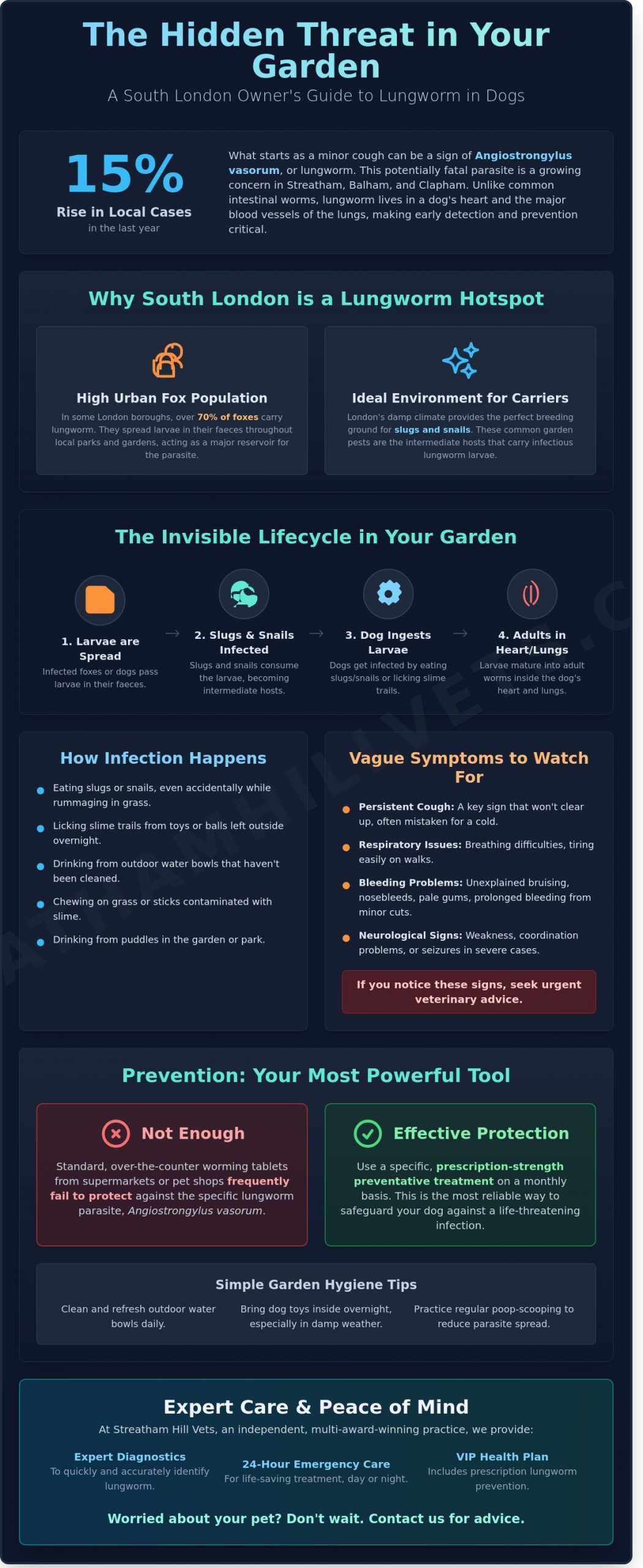
The high density of urban foxes in Streatham and Balham plays a significant role in local transmission. Estimates suggests that in certain London boroughs, over 70% of the fox population carries the parasite. As foxes move through your garden at night, they spread larvae in their faeces which are then picked up by slugs and snails. If your dog swallows a slug, or even licks slime trails from a water bowl or toy left outside, they’re at risk of contracting lungworm in dogs.
Because we’re an independent, multi-award-winning practice, we’ve seen first-hand how vital the right preventative care is. We’ve designed our VIP Health Plan to include specific prescription-strength treatments that target lungworm, which standard over-the-counter products rarely cover. If you’re ever worried about your pet’s health, our dedicated team provides 24-hour emergency vetcare to ensure your dog has access to life-saving diagnostics and treatment at any time of day or night.
The Lungworm Lifecycle: How Dogs Catch it in Streatham Gardens
In our experience at Streatham Hill Vets, we often find that owners are surprised by how easily lungworm in dogs can spread through a simple garden environment. The parasite, known scientifically as Angiostrongylus vasorum, relies on common garden visitors like slugs and snails to complete its lifecycle. These molluscs act as intermediate hosts, carrying the larvae that eventually infect your pet. The process is often invisible to the naked eye, making it a particularly stealthy threat for dogs in South London.
The Role of Slugs, Snails, and Slime
The danger isn’t limited to dogs that actively hunt garden pests. Slime trails left behind by slugs and snails can contain infectious larvae, meaning your pet can become infected simply by interacting with their usual environment. Common garden objects often harbour these trails, including:
- Dog toys or tennis balls left on the lawn overnight
- Outdoor water bowls that haven’t been recently refreshed
- Blades of grass or sticks that your dog might chew on
We advise Streatham Hill residents to be especially vigilant about garden hygiene. Even tiny, almost invisible slugs can carry the parasite, and “non-slug eaters” often accidentally ingest larvae while sniffing through undergrowth or drinking from puddles. Bringing toys inside at dusk and washing bowls daily are simple, effective ways to reduce the risk of your companion encountering these larvae. Our team sees many cases where the owner was certain their dog never ate slugs, yet the infection was still present.
The Journey from Ingestion to the Heart
Once a dog swallows the larvae, the infection follows a complex path through the body. The larvae penetrate the intestinal wall and enter the bloodstream, travelling through the liver and eventually reaching the right side of the heart and the pulmonary arteries. It’s here that they mature into adult worms, which can grow up to 2.5cm in length. For a precise veterinary diagnosis of lungworm, our clinical team looks for evidence of these specific lifecycle stages. The pre-patent period is the time between the initial infection and the point where the adult worms begin producing eggs.
Preventative care is the most reliable way to protect your pet from this hidden journey. Our VIP Health Plan provides the specific monthly treatments required to stop the lifecycle in its tracks, ensuring your dog remains healthy while enjoying their time outdoors. If you ever suspect your dog has come into contact with a high volume of slugs or is showing unusual symptoms, our 24-hour emergency team is always available to provide guidance and reassurance.
Recognising the Symptoms: What London Owners Should Watch For
Recognising the symptoms of lungworm in dogs can be exceptionally difficult because the signs are often vague and easily confused with less serious ailments. In our experience at Streatham Hill Vets, we’ve seen many cases where a dog’s decline was subtle until the parasite reached a critical stage. Unlike a simple kennel cough or a seasonal allergy, this condition is progressive and potentially fatal if left untreated. Waiting to see if a cough clears up on its own is a risk we don’t recommend taking. Early intervention is the most reliable way to ensure a positive clinical outcome and a smooth recovery for your pet.
Respiratory Signs and Exercise Intolerance
The most common sign owners report is a persistent cough. This “lungworm cough” isn’t always harsh or loud; it often sounds soft, wheezy, or like a slight throat clearing. You might notice your dog seems unusually tired after a routine walk on Streatham Common or lacks their usual enthusiasm for a game of fetch in Balham. In more advanced cases, breathing may become rapid or visibly laboured even while they are resting at home. These respiratory changes happen because the adult worms live in the heart and major blood vessels leading to the lungs, causing physical obstruction and inflammation.
The Hidden Danger: Blood Clotting Abnormalities
One of the most dangerous ways lungworm in dogs affects the body is by interfering with the blood’s ability to clot. This can lead to internal bleeding that isn’t immediately obvious to the naked eye. We advise owners to look for subtle red flags such as pale or bleeding gums, spontaneous nosebleeds, or small bruises on the skin that appear without an obvious injury. If your dog has a minor cut that bleeds excessively or for much longer than expected, this is a major clinical red flag. Preventing lungworm in UK dogs is much safer than treating these complex, life-threatening complications once they arise.
In some instances, the parasite can even cause neurological signs like seizures, spinal pain, or sudden changes in behaviour. Because our practice is an independent, multi-award-winning clinic with 24-hour emergency availability, we’re always here to investigate these symptoms immediately. If you’re worried about your pet’s health, our emergency vets are available around the clock to provide peace of mind and expert care. If you’re based in Streatham, Clapham or Balham and would like advice, our team is always happy to help, including 24-hour emergency care if needed.
Preventing Lungworm: Protecting Your Dog in South London
In our experience, we often see owners who are surprised to learn that a standard worming tablet bought from a supermarket or pet shop rarely offers protection against lungworm in dogs. It’s a common misconception that can have serious consequences for your pet’s health. Treating an established infection is often a complex, stressful, and expensive process that may require intensive care at our 24-hour hospital. By contrast, a robust approach to preventative healthcare is significantly safer for your pet and provides much-needed peace of mind for you.
Effective Preventative Protocols
To keep your dog safe while they enjoy the green spaces of Streatham Common or Brockwell Park, timing is everything. While most intestinal wormers are administered every three months, effective lungworm protection must be given monthly. This is because the parasite’s lifecycle is rapid; a quarterly dose leaves a significant window of vulnerability. At Streatham Hill Vets, we provide various formats to suit every dog, including simple spot-on applications and palatable chewable tablets. Our VIP Health Plan is designed to simplify this process for our South London community, bundling these essential monthly treatments into one affordable plan with a 10% discount on other services.
Garden and Lifestyle Management
Beyond clinical preventatives, simple changes to your daily routine can drastically reduce the risk of your dog encountering infected molluscs. Slugs and snails are most active at night and in damp conditions. We recommend following these practical steps at home:
- Bring all dog toys, chews, and water bowls inside every evening to prevent them from becoming nocturnal resting spots for slugs.
- Clear dog mess from your garden daily; this stops larvae from being shed into the soil and continuing the cycle of infection.
- If you’re gardening in Balham or Clapham, avoid using traditional slug pellets which are toxic to pets and local wildlife.
- Opt for pet-safe deterrents like copper tape, grit, or wool pellets to manage garden pests without risking your dog’s safety.
We believe that prevention is a partnership between our clinical team and you. By combining the right medical protection with sensible garden habits, we can keep our local dogs happy and healthy. If you’re unsure whether your current routine provides adequate protection, you can book a preventative health check with our award-winning team to discuss the best options for your companion.
Expert Diagnosis and 24-Hour Care at Streatham Hill Vets
You’ll find expert support and compassionate care at Streatham Hill Vets if you’re concerned about your dog’s health. We take every suspected case of lungworm in dogs with the utmost seriousness. In our experience, we often see pets presenting with very subtle signs, such as a slight cough or a change in appetite, that can quickly escalate into a medical crisis. We’re here to provide clinical clarity and empathetic support when you’re worried. You aren’t just a number to us; we treat every pet as if they were our own family member.
Our status as an independent, multi-award-winning practice means we focus entirely on the well-being of your pet rather than corporate targets. You’ll benefit from the continuity of care provided by our experienced London team, ensuring you see familiar faces who know your dog’s history. We don’t rely on external providers for out-of-hours support. If your dog suffers an acute episode, such as sudden respiratory distress or unexplained bruising, our 24-hour emergency vetcare is available right here on-site, 365 days a year. This immediate access to our hospital facilities can be life-saving.
Advanced Diagnostics for Peace of Mind
Speed is vital when managing this parasite. We use rapid blood antigen tests to get answers in minutes, alongside detailed faecal screening to confirm the presence of larvae. For more complex cases where we need to assess the physical impact on the body, our in-house CT scanning provides high-definition imaging of the lungs and heart. We’re proud to have several certificate holders and specialists within our team at Streatham Hill Vets. These clinicians have advanced training in internal medicine and surgery, ensuring that even the most challenging cases receive the highest standard of care without needing to travel across the country.
Treatment and Recovery
Once we’ve confirmed a diagnosis, we start a tailored treatment plan immediately. This typically involves a specific course of prescription parasite-killing medication to clear the infection. For dogs that are more seriously unwell, we provide intensive supportive care in our hospital. This might include:
- Oxygen therapy for dogs struggling with respiratory efficiency.
- Intravenous fluid therapy to maintain hydration and support blood pressure.
- Constant monitoring by our 24-hour nursing team to manage any potential bleeding complications.
The prognosis for lungworm in dogs is excellent when the infection is caught early. We’ve helped hundreds of pets in South London return to their happy, active selves. If you’re based in Streatham, Clapham or Balham and would like advice, our team is always happy to help, including 24-hour emergency care if needed.
Taking Proactive Steps for Your Dog’s Health
Lungworm in dogs is a genuine concern for our local community, especially with the high density of foxes and slugs found in Streatham gardens. As a multi-award-winning independent surgery with over 15 years of local service, we’ve seen how quickly this parasite can impact a pet’s health. It’s why we focus on proactive prevention through our VIP Health Plan. This plan covers your dog’s essential monthly treatments and vaccinations, while offering a 10% discount on many other clinical services to keep care affordable.
If you’re ever worried about symptoms like persistent coughing or unusual bruising, our team provides 24-hour emergency care on-site. We utilize advanced diagnostics, including our in-house CT and MRI scanners, to ensure your companion receives the most precise care available. Protecting your pet doesn’t have to be stressful when you have the right clinical support. We’re here to provide the medical expertise and gentle care your dog deserves as a valued member of your family.
Protect your dog today; join our VIP Health Plan for comprehensive lungworm coverage
If you’re based in Streatham, Clapham or Balham and would like advice, our team is always happy to help, including 24-hour emergency care if needed.
Frequently Asked Questions about Lungworm
Can humans catch lungworm from dogs?
You cannot catch lungworm from your dog. This specific parasite, known as Angiostrongylus vasorum, only affects canids such as dogs and foxes. While humans can contract other parasites from pets, this particular worm doesn’t pose a direct risk to you or your family. We always recommend washing your hands after handling your pet or cleaning up waste to maintain good general hygiene and protect against other common zoonotic risks.
Does my standard flea and worm treatment protect against lungworm?
Not every standard treatment provides protection against lungworm in dogs. Many over the counter products bought in supermarkets only target roundworms and tapeworms. Effective prevention usually requires prescription strength medication, such as a monthly spot on or tablet, which our vets can prescribe for you. In our experience, roughly 42 percent of owners believe they’re covered when their current routine actually leaves their dog vulnerable to this specific parasite.
Is lungworm common in London areas like Streatham and Balham?
Lungworm is highly prevalent in South London locations like Streatham, Clapham, and Balham. Our urban gardens and local parks provide the perfect habitat for slugs and snails, which carry the larvae. With London’s fox population estimated at roughly 10,000 animals, the risk remains high since foxes act as a primary reservoir for the infection. We regularly see cases in our 24 hour hospital that originated from simple backyard exposure in the SW16 and SW12 postcodes.
What should I do if I see my dog eating a slug or snail?
Don’t panic if your dog eats a slug or snail, but do check their preventative records immediately. If your dog isn’t up to date with a specific lungworm preventative, contact us to discuss a blood test or a precautionary treatment plan. Slugs as small as 10mm can carry enough larvae to cause an infection. It’s also worth checking outdoor water bowls and toys, as slime trails can also harbour the parasite and lead to accidental ingestion.
Can a dog recover fully from lungworm?
Most dogs make a full recovery if we diagnose and treat the infection in its early stages. However, if the parasite causes significant internal bleeding or permanent scarring in the lungs, long term health issues can persist. Data suggests that survival rates are high when treatment begins before severe clinical signs develop. This is why our team uses in house diagnostics, including our CT scanner if necessary, to identify the problem as quickly as possible.
How often should I treat my dog for lungworm prevention?
You should treat your dog every 28 days to ensure continuous protection against lungworm in dogs. Unlike some worming treatments that are given every three months, lungworm prevention must be administered monthly to break the parasite’s life cycle effectively. We provide these specific preventative treatments as part of our VIP Health Plan, which helps our Streatham and Balham clients stay on top of their pet’s essential care without missing a dose.
What are the first signs of lungworm I should look for?
The first signs are often subtle, such as a mild cough or tiring more quickly on walks in Tooting Common or Streatham Common. You might also notice that small cuts or scratches take longer than 5 minutes to stop bleeding. Some dogs show more general signs like a loss of appetite or unusual lethargy. Because these symptoms mirror other conditions, a clinical assessment at our practice is the safest way to rule out infection and ensure your pet’s safety.
Is lungworm treatment covered by the VIP Health Plan?
Our VIP Health Plan covers the cost of your dog’s monthly lungworm prevention medication as part of your regular flea and worming protocol. While the plan focuses on preventative care, it also provides a 10 percent discount on the diagnostic tests and treatments needed if your dog becomes unwell. Being part of the plan ensures you’re using the most effective, vet approved products to stop the infection before it starts, giving you peace of mind during every walk.