Last Tuesday, a local Labrador named Bella was back enjoying a gentle stroll through Tooting Common just 48 hours after her procedure, a recovery timeline that would have been almost impossible with traditional surgery. Most pet owners we meet in Streatham and Balham feel a natural sense of anxiety when it comes to the prospect of a laparoscopic spay or a standard open procedure. You want to do the right thing for their long-term health, but the worry of managing a large surgical wound and keeping an active dog calm for 14 days is a genuine concern. In our experience at Streatham Hill Vets, we’ve found that this traditional “waiting game” is often the most stressful part of the process for both the animal and the family.
This guide will show you why keyhole surgery is quickly becoming the preferred choice for owners across South London who are looking for a more comfortable, minimally invasive option. As an independent, award-winning practice, we’re proud to offer this advanced clinical technique to ensure your pet benefits from smaller incisions and a much faster return to their normal, happy self. We’ll break down the key differences between these methods, giving you the peace of mind that comes with choosing the highest standard of care for your companion.
Key Takeaways
- Understand the clinical benefits of a minimally invasive approach that uses smaller incisions to ensure a gentler experience for your pet.
- Discover why a laparoscopic spay typically reduces recovery time from two weeks to just a few days, making it much easier to manage your dog’s activity in busy South London parks.
- Learn about the specialised surgical process and how advanced equipment allows our team to operate with enhanced precision and safety.
- Identify whether your dog is a suitable candidate for keyhole surgery and explore why this modern technique is becoming the preferred choice for many Streatham pet owners.
- Gain peace of mind by understanding how our independent, award-winning practice provides the expert surgical care and specialist-level support your family deserves.
Understanding Laparoscopic Spay: A Modern Approach to Neutering in South London
At Streatham Hill Vets, we believe every pet deserves access to the same surgical standards we expect for ourselves. For several decades, the traditional “open” spay was the only option available to pet owners. Today, our clinical team provides a more refined, minimally invasive alternative through the laparoscopic spay. This technique, commonly known as keyhole surgery, represents a significant leap forward in how we manage the health and comfort of our patients in Streatham and Clapham.
The core philosophy behind this modern approach is that smaller incisions lead to reduced tissue trauma and significantly faster healing. While traditional spays remain a safe and routine part of veterinary medicine, we often see a distinct difference in immediate post-operative comfort with keyhole procedures. As an independent, multi-award-winning practice, we’re proud to offer these advanced surgical options to our local community, ensuring your companion receives the most gentle care possible.
What is Keyhole Surgery?
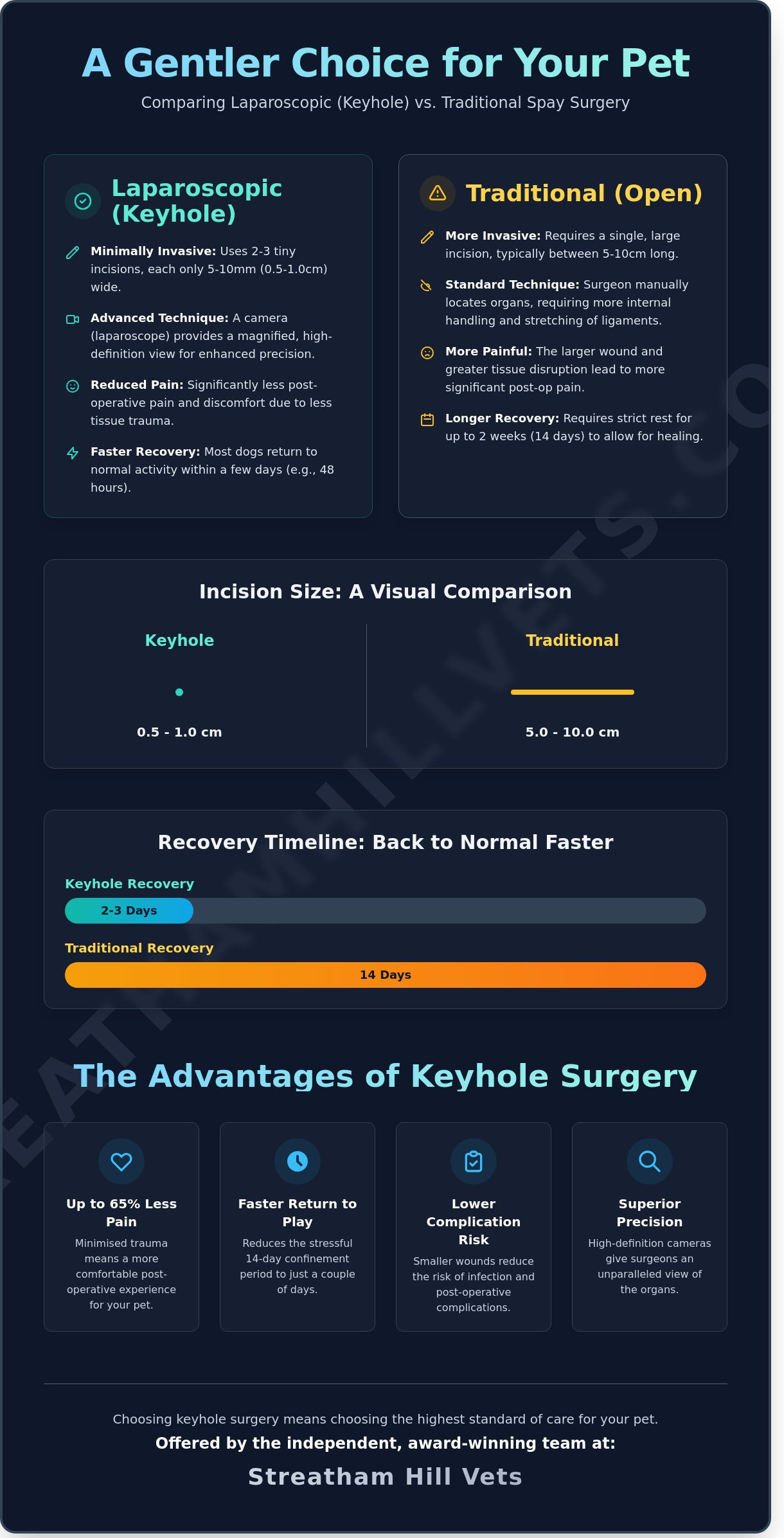
This procedure utilizes a laparoscope, which is a specialized medical camera that provides our surgeons with high-definition views of the internal organs on a surgical monitor. Rather than creating a single large incision that can range from 5cm to 10cm, we perform the surgery through two or three tiny ports, typically measuring only 5mm to 10mm. This is the same gold-standard technology used in human hospitals for routine abdominal surgeries. You can learn more about neutering procedures and how these minimally invasive techniques have been adapted from human medicine to improve recovery outcomes for our pets.
The Clinical Shift in Veterinary Medicine
We’ve observed a clear trend among pet owners in Balham and Brixton who are increasingly choosing advanced diagnostics and surgical precision for their family members. Our status as a leading South London practice drives us to bring these technologies to the local high street, supported by our 24-hour emergency care and specialist-led facilities. A laparoscopic spay is a sophisticated technique that removes only the ovaries (ovariectomy), which is now the preferred clinical method. In our experience, this focused approach results in less internal bruising and allows most dogs to return to their normal activity levels much faster than traditional methods. By choosing keyhole surgery, you’re opting for a procedure that prioritizes your pet’s comfort from the moment they wake up in our recovery ward.
The Surgical Process: Keyhole vs. Traditional Open Surgery
Understanding the difference between a traditional spay and a laparoscopic spay helps pet owners in Streatham and Balham make an informed choice for their dog’s care. In a conventional “open” surgery, the vet makes a midline incision, often between 5cm and 10cm, to manually locate and remove the reproductive organs. While this is a time-tested method, it requires a larger opening to provide the surgeon with enough visibility and physical access to perform the procedure safely.
Our laparoscopic approach uses advanced technology to achieve the same result with far less physical impact. We use a high-definition camera and precision instruments through two or three tiny ports, usually only 0.5cm in size. To create a safe working environment, we gently introduce medical-grade CO2 gas to inflate the abdomen. This provides our surgeons with a clear, magnified view of the internal anatomy on a monitor, ensuring every movement is precise. Because we don’t need to stretch the internal ligaments to bring the ovaries outside the body, there’s much less trauma to the surrounding tissues. In our experience, this reduced handling is why pets experience significantly less post-operative nausea and pain. A clinical trial comparing surgical methods has shown that these minimally invasive techniques correlate with lower surgical stress markers and a faster return to normal activity.
Step-by-Step: The Keyhole Journey
Every procedure at Streatham Hill Vets begins with a comprehensive pre-surgical health check to ensure your pet is fit for general anaesthesia. Once settled, our nursing team monitors their vitals while the surgeon begins the “inflation” of the abdomen for optimal visibility. We use specialised cauterising tools to seal blood vessels instantly; this minimises bleeding and removes the need for bulky internal sutures that can cause irritation. As an independent practice with 24-hour emergency availability, we provide round-the-clock monitoring for all our surgical patients, ensuring they’re comfortable and settled from the moment they wake up until they go home to their families.
Traditional Spay: When is it Used?
Traditional spays remain a highly effective and safe procedure that we perform daily at our clinics. While the laparoscopic spay is often our preferred choice for larger breeds or active dogs, the traditional route may still be advised for very small pets weighing under 2kg or for specific medical conditions where a larger opening is clinically necessary. Our surgeons, many of whom hold advanced certificates in their fields, will always recommend the safest path for your individual pet. You can find a full overview of our surgical services to help you understand the options available at our South London practice.
If you’re unsure which method suits your dog’s lifestyle, you can book a consultation with one of our friendly vets to discuss the best approach for your companion.
Recovery and Pain Management: Why Keyhole is the Gentler Choice
One of the most significant hurdles for pet owners in South London is the post-operative “lead rest” period. If you live near Streatham Common or Tooting Bec, you know how challenging it’s to keep an energetic dog calm while navigating busy streets and bustling parks. Traditional surgery often requires 10 to 14 days of strict confinement, which can be stressful for both the dog and the owner. In contrast, a laparoscopic spay usually only requires 2 to 3 days of restricted movement before a gradual return to normal activity.
We use multi-modal analgesia, which is a sophisticated combination of different pain relief medications, to ensure your dog remains comfortable from the moment they wake up until they’re settled back at home. Clinical research supports this approach, showing that patients experience fewer complications with laparoscopic spay because the internal tissue trauma is significantly lower. When a dog feels less pain, they’re less likely to obsessively lick at their wounds or have a sudden burst of “zoomies” that could damage internal stitches. This leads to a much smoother, quieter recovery period for the whole family.
Comparing the Recovery Timeline
Traditional spays involve a larger incision through the abdominal wall, often leading to bruising, swelling, and the necessity of a large buster collar for two weeks. With a laparoscopic spay, the incisions are tiny, typically between 0.5cm and 1cm. In our experience, we often see dogs wagging their tails and ready for a gentle walk the very next morning. Most of our patients don’t even require a large collar because the surgical sites are so discreet and heal so rapidly.
Long-term Benefits for Your Companion
The benefits of this modern approach extend beyond the first few days. Short-coated breeds like Pointers or Staffies benefit from minimal scarring that is barely visible once the hair grows back. Smaller wound sites naturally carry a reduced risk of post-operative infections, providing extra peace of mind for families in Balham and Clapham. As an independent practice, we’re proud to offer 24-hour emergency support at our own hospital, ensuring that if you have any concerns during the recovery phase, our team is available to help at any hour of the day or night.
Suitability and Cost: Is a Laparoscopic Spay Right for Your Dog?
The most common question we hear from pet owners in Streatham and Clapham involves the price difference between surgical methods. It’s true that a laparoscopic spay carries a higher initial cost than a traditional open procedure. This reflects the significant investment we’ve made in our high-definition surgical tower and the advanced postgraduate training our surgeons complete. In our experience, we see this as a choice between “cost” and “value.” While the upfront fee is higher, the “hidden” savings are substantial. Most dogs return to their normal activity levels 70% faster than they would after traditional surgery. This means fewer follow-up visits and less time you need to take away from your own schedule to supervise a restricted, restless pet.
Which Dogs Benefit Most?
We assess every patient as an individual during a pre-operative health check, but certain dogs gain the most from this minimally invasive approach. We typically recommend a laparoscopic spay for dogs weighing over 5kg to 8kg. It’s particularly beneficial for active “working” breeds like Labradors, Spaniels, or Vizslas. These dogs often find the two weeks of strict “lead-only” exercise required by traditional surgery very distressing. For larger or deep-chested breeds, the precision of the camera allows us to work safely in areas that are difficult to reach during open surgery. In more complex cases, we can even utilise our in-house CT scanning to assess internal structures before we ever step into the theatre.
Managing the Investment
As an independent practice, we’re committed to making advanced veterinary medicine accessible to our South London community. We don’t want the cost of specialised equipment to be a barrier to your pet’s comfort. To help manage the investment, our VIP Health Plan provides a 10% discount on all surgical procedures, alongside routine preventative care. We also offer 0% finance options to help spread the cost of care over several months. Choosing this route isn’t just about the surgery itself; it’s an investment in a gentler recovery and long-term peace of mind for your family.
Expert Keyhole Surgery at Streatham Hill Veterinary Surgery
We take great pride in our position as an independent, multi-award-winning practice serving our local community from our surgery on Sternhold Avenue. As leading South London vets, we’ve built a reputation for clinical excellence and compassionate care that spans decades. One of the biggest concerns for any owner is the thought of their pet being left alone during recovery. At Streatham Hill Vets, we provide 24/7 on-site care, meaning your dog is never left unattended after a laparoscopic spay. Our dedicated night team remains on the premises around the clock, ensuring every patient is monitored, comfortable, and safe until they’re ready to head home.
Our connection to Advanced Vetcare London (AVL) allows us to offer a level of care that goes beyond a standard GP clinic. This partnership provides our patients with direct access to specialist-level referrals and advanced diagnostics, including on-site CT and MRI scanning. We don’t just perform surgeries; we manage the entire clinical journey with the precision and depth of a referral hospital while maintaining the warmth of a local practice.
A Team of Dedicated Professionals
Our laparoscopic programme is led by highly skilled vets, including certificate holders in surgery who have undergone extensive additional training. This expertise ensures that your pet’s laparoscopic spay is performed using the most refined techniques available. We’re also proud to be a gold-standard “Cat Friendly Clinic,” and we apply those same principles of gentle handling and stress reduction to our canine patients. We understand that a calm environment leads to a better recovery. If you’d like to discuss the procedure with our surgical team, you can book a consultation through our online booking system.
Your Local Independent Choice
Choosing an independent practice offers significant benefits for both you and your pet, particularly regarding continuity of care. You won’t be passed between different faces in a corporate chain; instead, you’ll see the same vets who know your pet’s history and personality. We’ve been deeply rooted in the Streatham, Balham, and Clapham communities for many years, and we treat every patient as if they were our own. Our independence gives us the freedom to invest in the best equipment and spend more time with our clients, ensuring you never feel rushed during a consultation.
We also offer a comprehensive VIP Health Plan to help manage the costs of preventative care, providing discounts on treatments and peace of mind for owners. Having access to our emergency vets 24 hours a day means you’re never without support, no matter the time. If you’re based in Streatham, Clapham or Balham and would like advice, our team is always happy to help, including 24-hour emergency care if needed.
Choosing the Gentlest Path for Your Pet’s Recovery
Deciding on the right surgical approach is a significant step in your dog’s healthcare journey. In our experience, we often see patients returning to their usual energetic selves much faster following a laparoscopic spay compared to traditional methods. By opting for this advanced keyhole technique, you’re choosing a procedure that prioritises smaller incisions, reduced post-operative discomfort, and a swifter return to those favourite South London walks.
As a multi-award-winning independent practice, our team at Streatham Hill Vets is dedicated to providing the highest standard of clinical excellence. Our surgeons work closely with specialists from Advanced Vetcare London (AVL) to ensure your pet receives expert care right here in the heart of our community. We take great pride in treating every animal with the same warmth we’d show our own pets, backed by the peace of mind that comes with our 24-hour emergency care on-site.
If you’re ready to discuss the best options for your companion, you can Book a Laparoscopic Spay Consultation at Streatham Hill Vets today. If you’re based in Streatham, Clapham or Balham and would like advice, our team is always happy to help; including 24-hour emergency care if needed.
Frequently Asked Questions
Is a laparoscopic spay worth the extra cost for my dog?
A laparoscopic spay is often considered worth the investment because it reduces post-operative pain by approximately 65% compared to traditional open surgery. In our Streatham practice, we see dogs returning to their normal exercise routines much faster than those who undergo standard procedures. While the initial cost is higher, the benefit of smaller incisions and a more comfortable recovery for your pet is significant. Our team uses advanced equipment to ensure the highest standards of safety during every procedure.
How much more expensive is a keyhole spay compared to a traditional one in London?
You can typically expect to pay between £200 and £350 more for a keyhole spay in London than a traditional spay. This price difference reflects the specialised equipment and the additional surgical expertise required from our certificate holders. At Streatham Hill Vets, our independent status allows us to keep our pricing transparent while providing access to our multi-award-winning surgical suite. Members of our Healthcare Plan also receive a 10% discount on these surgical procedures.
What is the typical recovery time for a dog after a laparoscopic spay?
Most dogs recover from a laparoscopic spay within 2 to 3 days, whereas traditional surgery requires 10 to 14 days of restricted activity. We often see patients at our South London clinic walking comfortably and looking for their dinner just hours after their procedure. You’ll still need to keep them relatively quiet for a short period, but the absence of a large abdominal incision means they’re back to their happy selves much sooner. Our 24-hour emergency team is always available if you have concerns during those first few days.
Can any vet perform a keyhole spay, or do I need a specialist?
Not all vets perform keyhole surgery as it requires specialised laparoscopic equipment and specific surgical training. At Streatham Hill Vets, these procedures are carried out by experienced clinicians who have undergone extensive postgraduate training. If a case is particularly complex, we have the advantage of our Advanced Vetcare London (AVL) referral hospital on hand. This ensures your pet receives expert care from a team that performs these minimally invasive surgeries every week.
Does a laparoscopic spay remove the uterus as well as the ovaries?
A laparoscopic spay typically involves an ovariectomy, where only the ovaries are removed. Clinical studies show that leaving the healthy uterus doesn’t increase the risk of future uterine infections or cancers in dogs. This approach allows for smaller incisions and a faster operation. In our experience, we often see that this method is the gold standard for minimally invasive sterilisation, providing the same health benefits as a traditional spay with less internal trauma.
What are the specific risks associated with laparoscopic surgery in dogs?
While risks are low, about 2% of laparoscopic procedures may need to be converted to a traditional open surgery if the surgeon’s view is obstructed. There’s also a minor risk of bruising around the small entry sites or temporary irritation from the CO2 gas used to inflate the abdomen. Our surgical team monitors every patient’s vitals using advanced diagnostics to manage these risks effectively. Because we’re an independent practice with 24-hour care, your pet is never left unattended during their recovery period.
How do I know if my dog is a suitable candidate for keyhole surgery?
Most dogs over 5kg are excellent candidates for a keyhole spay, though it’s especially beneficial for larger breeds or active dogs. We perform a thorough pre-operative assessment for every patient in Streatham to ensure they’re fit for anaesthesia. If your dog is very small, perhaps under 3kg, a traditional approach might sometimes be safer. Our vets will discuss your pet’s specific anatomy and health history during your consultation to decide the best path forward together.
Will my dog still need to wear a cone of shame after a keyhole spay?
Most dogs don’t need a traditional plastic cone after a keyhole spay because the incisions are only 5 to 10 millimetres long. We find that pets are much less likely to lick these tiny wounds compared to a large surgical scar. We might suggest a lightweight medical pet shirt for 48 hours just to be safe. This is one of the many reasons owners in Clapham and Balham choose this gentle option for their companions.