The closest or most familiar veterinary practice isn’t always the right one for your beloved companion. We understand; when your pet is unwell or it’s time for their annual check-up, the sheer number of options can feel overwhelming. It’s completely natural to worry if you’re making the best choice, especially when trying to decipher the differences between large corporate groups and a local, independent surgery.
This guide is designed to bring you clarity and peace of mind. We promise to help you understand the vital role of a modern veterinarian and equip you with a practical checklist for finding exceptional care. Together, we’ll explore the different types of veterinary services available and explain what truly sets an outstanding practice apart, ensuring you feel confident and prepared for routine visits and unexpected emergencies alike.
Key Takeaways
- Discover the essential qualifications and responsibilities that define a modern vet’s role, from routine check-ups to life-saving surgery.
- Learn how advanced diagnostics, similar to those in human healthcare, can provide faster, more accurate treatment for your beloved pet.
- Identify the key factors to consider when choosing a veterinarian, looking beyond just location to assess the quality and range of services offered.
- Understand the crucial questions you should ask a practice about their on-site facilities and emergency care capabilities before registering.
What is a Veterinarian? Defining the Role of Your Pet’s Doctor
Choosing the right doctor for your beloved companion is one of the most important decisions you’ll make as a London dog owner. A veterinarian is far more than just an ‘animal doctor’; they are a highly trained medical professional and a dedicated partner in your pet’s lifelong health journey. At its core, the answer to ‘What is a Veterinarian?’ points to a professional who has completed years of extensive education to diagnose, treat, and prevent diseases in animals, acting as a guardian of their wellbeing.
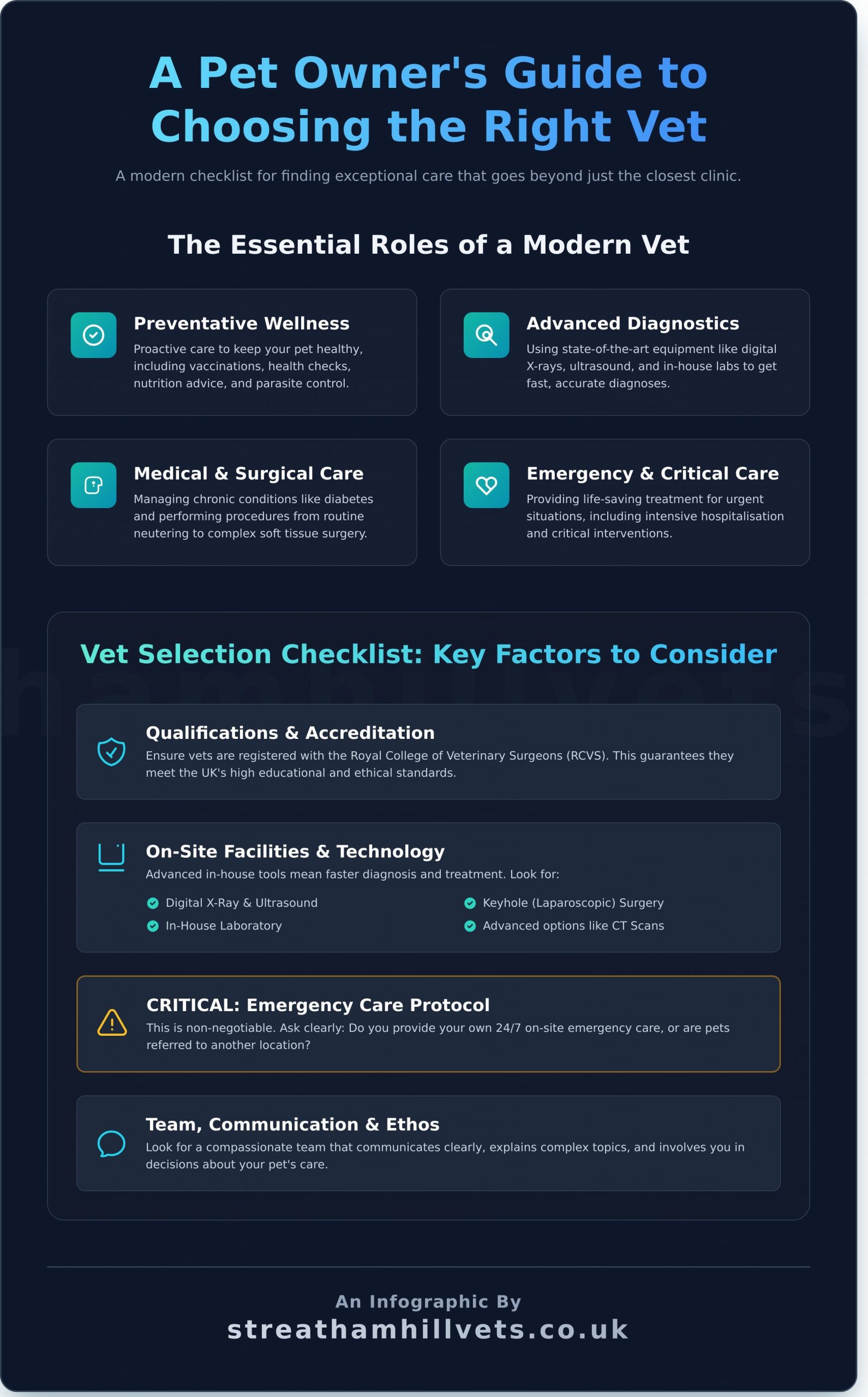
Here in the UK, the profession is held to exceptionally high standards. To practise legally, every vet must be registered with the Royal College of Veterinary Surgeons (RCVS). This isn’t just a formality; it’s a guarantee that your pet’s doctor has met rigorous educational and ethical benchmarks, ensuring they are qualified to provide the highest level of care. This registration, which allows them to use the letters MRCVS after their name, provides you with complete peace of mind.
The role of your local vet is incredibly diverse, covering the full spectrum of your dog’s needs. We act as your primary point of contact for everything from routine preventative care to critical emergencies. A typical day for our team might involve:
- Preventative Wellness: Conducting thorough health checks, administering vital vaccinations, and offering advice on nutrition and parasite control to keep your dog happy and healthy.
- Advanced Diagnostics: Using state-of-the-art equipment to investigate illnesses, from in-house blood tests and digital X-rays to detailed ultrasound scans.
- Complex Medical Management: Treating chronic conditions like arthritis or diabetes with tailored, long-term care plans.
- Emergency and Critical Care: Providing life-saving treatment around the clock, including complex surgical procedures and intensive hospitalisation.
Beyond the clinical skills, a modern vet serves a crucial role as a compassionate guide for you, the owner. We understand that your dog is a cherished family member. Our job is to translate complex medical information into clear, understandable advice, empowering you to make the best decisions for your companion. We are here to offer reassurance during anxious times and celebrate with you when your pet is thriving.
The Difference Between a Vet and a Specialist
Think of your local vet as a GP for your pet. We handle the vast majority of health needs, from annual check-ups to common ailments. However, for highly complex conditions like specific heart diseases or cancers, we may refer you to a specialist. These are vets who have undertaken years of additional, intensive training in a specific field, such as cardiology or oncology, to become a recognised expert and provide advanced procedures.
Why the Term “Veterinary Surgeon” is Used in the UK
In the UK, the official title is ‘Veterinary Surgeon,’ and ‘vet’ is simply the common abbreviation. This title isn’t accidental; it underscores the fact that surgery is a fundamental component of our training and daily work. From routine procedures like neutering to intricate soft tissue operations, surgical expertise is a core skill for every qualified veterinarian in the country, reflecting the comprehensive nature of the profession as governed by the RCVS.
The Essential Roles and Responsibilities of a Modern Vet
When you bring your beloved companion to us, you’re placing their trust in our hands. The role of a modern vet extends far beyond simply treating illness; it’s a deep, multifaceted partnership dedicated to every stage of your pet’s life. It involves a sophisticated blend of diagnostic skill, surgical precision, and preventative strategy. The official Essential Roles and Responsibilities of a Modern Vet outline a profession that requires expertise across numerous species and medical disciplines, a standard we proudly uphold in our London practice.
Our days are incredibly varied. One moment, we might be diagnosing a complex autoimmune condition in a dog; the next, performing life-saving surgery to remove an intestinal blockage. We are trained to handle everything from routine procedures, like neutering, to intricate orthopaedic repairs. This broad skill set is essential, as our patients can’t tell us where it hurts. It’s our job to be their voice, using advanced diagnostics and clinical experience to uncover the root of the problem and provide gentle, effective treatment.
Preventative Healthcare: The Foundation of Wellbeing
We believe the most powerful medicine is prevention. By stopping diseases before they can take hold, we give your pet the best possible chance at a long, happy, and comfortable life. This proactive approach is built on several key pillars:
- Routine Vaccinations: Core vaccinations are non-negotiable for protecting your pet from devastating diseases. In London, this includes safeguarding dogs against parvovirus, which saw a reported 74% rise in UK cases between 2020 and 2021, as well as protecting cats from cat flu and rabbits from RHD.
- Targeted Parasite Control: London’s green spaces, like Clapham Common, are wonderful for exercise but can harbour parasites. We provide tailored flea, tick, and worming treatments that account for local risks, including the growing threat of lungworm spread by slugs and snails.
- Annual Health Checks: For a senior pet (typically over 7 years old), a year is a long time. Annual check-ups allow us to spot subtle, early signs of age-related conditions like arthritis or kidney disease, enabling us to manage them long before they cause significant discomfort.
Emergency and Critical Care
Accidents and sudden illnesses are every owner’s worst fear, and they rarely happen during convenient hours. A dedicated veterinarian must be prepared to act decisively when the unexpected occurs. As one of London’s few independent, 24-hour emergency hospitals, we are always ready.
- Managing Critical Cases: Our team is equipped to handle severe trauma from road traffic accidents, acute toxicities from ingesting items like raisins or lilies, and sudden, life-threatening illnesses.
- The Importance of Overnight Care: Critical recovery often depends on round-the-clock monitoring. Our on-site hospital setting ensures your pet is never left alone, receiving continuous observation and care from our dedicated night team. This is a level of support that day-only clinics simply cannot offer.
- A Reassuring Presence: We understand how stressful an emergency is for you. A crucial part of our role is to provide clear communication and compassionate support, guiding you through difficult decisions with empathy and clinical expertise.
From a puppy’s first vaccination to emergency care in the middle of the night, our responsibilities cover the full spectrum of your pet’s needs. Choosing a vet means finding a team you can trust with every aspect of that journey. If you’d like to learn more about how our 24-hour care can support your pet, we are always here to talk.
Advanced Veterinary Care: CT Scans, Keyhole Surgery, and Beyond
As your local, independent veterinary team, we believe your beloved companion deserves the very best care available. The world of veterinary medicine has transformed over the last decade, and the technology we now use to diagnose and treat our patients often mirrors the advanced equipment found in human hospitals. This evolution allows our dedicated team to create faster, more precise treatment plans, ensuring your pet gets the help they need with less stress and discomfort.
This commitment to progress is a core part of our profession. The skills and tools at a modern veterinarian‘s disposal have grown significantly, a development highlighted in veterinary profession statistics that point towards increasing specialisation. For London pet owners, this means access to a higher standard of care right on your doorstep, from minimally invasive procedures to incredibly detailed diagnostic imaging.
Laparoscopic (Keyhole) Surgery for Pets
We are proud to offer a gentler alternative for procedures that once required significant surgery. Laparoscopic, or ‘keyhole’, surgery is a minimally invasive technique where we operate through tiny incisions, typically just 5-10mm long, using a specialised camera and instruments. This approach is a world away from traditional open surgery.
The benefits for your pet are substantial and scientifically proven. Studies have shown that keyhole procedures can result in:
- Up to 65% less post-operative pain for the animal.
- A significantly faster recovery time; pets are often back to their normal selves in 2-3 days, compared to 10-14 days for traditional surgery.
- A reduced risk of complications like infection due to smaller wounds.
This technique is the gold standard for procedures like bitch spays and for taking internal biopsies of organs like the liver or kidneys. For busy Londoners, knowing your companion can recover quickly and comfortably provides invaluable peace of mind, which is why this ‘gentler option’ is fast becoming the preferred choice.
Diagnostic Imaging: CT Scans and Ultrasound
A swift and accurate diagnosis is the first step towards effective treatment. While traditional X-rays are useful, they provide a flat, 2D image where internal structures can overlap. That’s where more advanced imaging comes in. A CT (Computed Tomography) scanner takes hundreds of X-ray images from different angles and uses a computer to create a detailed 3D model of your pet’s anatomy. This allows us to see complex joint issues, like elbow dysplasia in Labradors, or precisely map the location of a tumour with incredible clarity.
Ultrasound offers another powerful, non-invasive way to see inside the body in real-time. It uses sound waves to create images of soft tissues, making it perfect for assessing heart function (an echocardiogram) or examining abdominal organs like the bladder and spleen without any radiation. Having these state-of-the-art diagnostic tools on-site is a hallmark of a high-quality veterinary surgery. It means we don’t lose precious time referring you elsewhere; we can get the answers we need quickly and start treatment right away.
For specialised concerns, particularly for London’s popular flat-faced breeds, we also offer services like official BOAS (Brachycephalic Obstructive Airway Syndrome) grading. This helps owners of Pugs, French Bulldogs, and other brachycephalic dogs understand and manage their pet’s breathing. Ultimately, investing in this technology is about one thing: improving the health and happiness of your cherished family member.
How to Choose the Right Veterinarian for Your Pet
Selecting a veterinary practice in London is one of the most significant decisions you will make for your beloved companion. This partnership is built on trust, expertise, and a shared commitment to your pet’s lifelong health. While convenience is a factor, the quality of care, the range of available services, and the clinic’s core philosophy should be your guiding priorities. The reality is that not all practices are created equal; the differences in equipment, expertise, and approach can be vast.
A key consideration is whether a practice is an independent, vet-owned clinic or part of a large corporate chain. With over 50% of UK practices now under corporate ownership, choosing an independent clinic often means choosing a more personal, continuous line of care. An independent team is deeply rooted in the local community, building relationships with families over generations. This continuity ensures your pet is seen as an individual, not just a case file.
Furthermore, look for a practice that actively works to make vet visits less stressful. Accreditations like the ISFM’s ‘Cat Friendly Clinic’ or certifications in ‘Fear Free’ methods are not just badges; they represent a profound commitment to your pet’s emotional wellbeing. These approaches use gentle handling and calming environments to transform a potentially frightening experience into a positive one.
Checklist for Evaluating a Local Vet
When you are ready to choose, use these questions to assess the standard of care. Your pet deserves a team that is prepared for anything, day or night.
- Is the surgery open 24 hours a day, 365 days a year for emergencies? An emergency can happen at any time. A practice with round-the-clock, on-site care provides immense peace of mind, ensuring your pet is seen immediately by a familiar team in a familiar place, without the stress of being transferred to a separate out-of-hours provider.
- Do they have advanced diagnostic equipment? The ability to get a fast, accurate diagnosis is critical. Practices with on-site facilities like a CT scanner, digital X-ray, and a comprehensive laboratory can deliver results in hours, not days, leading to quicker and more effective treatment.
- Are they an independent practice? A long-standing, independent veterinarian often has a deep, personal investment in their reputation and community. This translates into a team that is dedicated, stable, and focused entirely on patient care rather than corporate targets.
- Do they offer preventative health plans? Proactive care is always better than reactive treatment. Many leading clinics offer plans that spread the cost of routine care, like vaccinations and parasite control, making it easier to budget and keep your pet protected throughout the year.
The Importance of a Compassionate Bedside Manner
Clinical skill is essential, but so is empathy. A great vet communicates with you clearly, listens to your concerns, and supports you through difficult decisions. They understand that you know your pet best. The entire team, from the receptionists to the nurses, should treat your pet with the same gentle respect they would their own. You can learn a lot by reading local reviews, paying close attention to how the team is described during stressful or emotional situations.
We believe this combination of advanced medicine and heartfelt compassion is what truly sets a practice apart. We invite you to learn more about our award-winning, independent hospital and discover the peace of mind that comes from knowing your pet is in the most capable and caring hands.
Streatham Hill Vets: Award-Winning Care in South London
Choosing the right care for your dog in London can feel overwhelming, but it doesn’t have to be. For pet owners in South London, finding a practice that combines clinical excellence with genuine, local warmth is the ultimate goal. At Streatham Hill Veterinary Surgery, we’ve built our reputation on being that trusted partner for your pet’s health. As a proudly independent and vet-owned practice, we have been a cornerstone of the Streatham community for years, offering a level of personal commitment that larger corporate chains simply can’t match.
Our dedication to providing the best possible outcomes for your beloved companions is reflected in our state-of-the-art facilities. We have invested heavily in cutting-edge diagnostic and surgical technology, including an on-site CT scanner for detailed internal imaging and dedicated keyhole surgery suites. This advanced equipment allows our team to perform less invasive procedures, which often means a faster, more comfortable recovery for your dog. It’s this commitment that sets us apart.
What truly defines us, however, is our team. We are one of the very few veterinary surgeries in London to provide true 24-hour emergency care on our own premises, staffed by our own dedicated team. This means that in an emergency, your pet will be seen by professionals who have immediate access to their full clinical history, ensuring seamless and consistent care when it matters most. Our multi-award-winning team of vets and nurses is driven by a shared passion for animal welfare, blending profound medical expertise with the gentle, empathetic approach every pet deserves.
Our Commitment to Your Pet’s Lifelong Health
We believe in building a relationship that lasts a lifetime. From the excitement of first puppy vaccinations and neutering to the specialised attention required for senior pet care, our team is here to guide you at every stage. To make exceptional preventative care simple and affordable, we created our VIP Pet Health Plans. These plans spread the cost of essential treatments like annual boosters, flea and worming prevention, and regular health checks, giving you complete peace of mind.
Why Streatham Hill Owners Trust Us
Our clients choose us because we offer the expertise of a leading London veterinarian with the friendly, approachable feel of a local practice. We know your pets by name and treat them as part of our own family. This local mentor personality, combined with our convenient location for owners in Streatham, Balham, Tooting, and Brixton, has made us a trusted pillar of the community. We invite you to experience the difference that dedicated, independent care makes. Book an appointment with our award-winning team today.
Partnering with the Right Vet for a Lifetime of Care
Choosing the right veterinarian is one of the most important decisions you’ll make for your pet. It’s about finding more than just a doctor; it’s about finding a lifelong partner in your companion’s health and happiness. As we’ve explored, modern veterinary care now offers incredible advancements, from preventative wellness plans to sophisticated diagnostics and minimally invasive surgeries, all designed to give our pets longer, healthier lives.
At Streatham Hill Vets, we are proud to offer that complete partnership. As a multi-award-winning, independent practice, we are owned and run by vets who are deeply committed to our community. We provide continuous, 24-hour care and have invested in on-site advanced technology, including CT scanning and keyhole surgery, to ensure your pet receives the best possible treatment right here with us. We believe every pet deserves this level of dedication.
If you’re ready to provide your beloved companion with exceptional care, we invite you to join our family. Register your pet with Streatham Hill Vets today and take the first step towards a future of health and peace of mind.
Frequently Asked Questions
What is the difference between a vet and a veterinarian?
There is no difference; “vet” is simply the common, shorter term for the professional title “veterinarian”. Both words refer to a medical professional who is qualified to diagnose and treat diseases and injuries in animals. In the United Kingdom, anyone using either title must be officially registered with the Royal College of Veterinary Surgeons (RCVS). It’s purely a choice between using the formal term or its more familiar, everyday abbreviation.
How do I know if my veterinarian is properly qualified?
A qualified UK veterinarian must be registered with the Royal College of Veterinary Surgeons (RCVS), which is the governing body for the profession. You can instantly verify a vet’s credentials by using the “Find a Vet” search tool on the official RCVS website. This register confirms they have met the strict educational and professional standards required to practise in the UK. This simple check provides complete peace of mind about your pet’s care.
Can a veterinarian treat all types of animals?
While all vets receive a broad education covering many species, most choose to specialise after qualifying. The majority of private practices in London focus on “small animals” like dogs, cats, and rabbits. Others may dedicate their careers to equine medicine (horses), farm animals, or exotic pets like reptiles and birds. It’s always wise to confirm a clinic has the specific expertise required for your beloved companion before registering with them.
Why are some veterinary surgeries open 24 hours while others are not?
Operating a 24-hour hospital requires a significant investment in dedicated night-time veterinarians and nurses, along with advanced on-site diagnostic and surgical facilities. Many standard clinics cannot sustain this model, so they partner with a separate emergency provider for out-of-hours care. We believe providing our own on-site, round-the-clock service is essential for continuity of care, ensuring your pet is always in a familiar place with a team that knows them.
What should I do if my pet has an emergency in the middle of the night?
You should immediately call a 24-hour veterinary hospital or your vet’s designated out-of-hours service. Don’t wait until morning, as many conditions can deteriorate very quickly. It’s a good idea to save your vet’s emergency number in your phone’s contacts right now. Calling ahead allows the team to give you vital first-aid advice and prepare for your arrival, ensuring your pet receives critical care the moment you walk through the door.
What is a “Cat Friendly Clinic” and why does it matter?
A “Cat Friendly Clinic” is an official accreditation awarded by the International Society of Feline Medicine (ISFM) to practices that meet higher standards for feline care. This matters deeply because vet visits can be incredibly stressful for cats. Accredited clinics have features like separate, quiet waiting areas for cats and staff who are specially trained in gentle handling techniques. This focus helps create a calmer, safer, and more positive experience for your cat. For times when you’re away, this commitment to a low-stress environment can be continued with professional sitting services like Mission Cats In-Home Care.
How often should my pet see a veterinarian for a check-up?
We strongly recommend an annual health check-up for most adult dogs and cats as a minimum. This yearly visit is crucial for preventative healthcare, including booster vaccinations, parasite control, and early disease screening. For senior pets, generally those over 7 years of age, we advise check-ups every six months. Since pets age so much faster than we do, these regular visits allow us to manage health changes before they become serious problems.
Are independent vets better than corporate veterinary groups?
The choice is a personal one, but independent practices offer distinct advantages in clinical freedom and continuity of care. This principle holds true across different fields of healthcare; for instance, many people prefer GP-owned medical practices for their families for the same reasons. To see an example of this model, you can learn more about The Village GP Black Rock. Seeing a familiar, trusted face who knows your pet’s history provides invaluable comfort and reassurance.