Last Tuesday, we welcomed a nervous Labrador named Barney and his owner, who had travelled from Balham through the usual South Circular congestion. Like many of our neighbours, Barney’s owner felt a heavy weight of anxiety at the thought of leaving his companion for a veterinary operation. It’s a feeling we encounter daily in our Streatham practice, where the bond between a family and their pet is at the heart of everything we do.
We know that the prospect of anaesthesia and surgery can feel overwhelming, especially when you’re worried about your pet being alone or navigating the local traffic for appointments. This guide will provide the clinical clarity you need to feel confident in your pet’s surgical journey. You’ll learn exactly how we prepare our patients, what happens during our expert-led procedures, and how our 24-hour on-site monitoring at our independent, multi-award-winning hospital ensures your pet is never truly alone during their recovery.
Key Takeaways
- Learn how our Streatham Hill vets diagnose your pet’s clinical needs and why a veterinary operation might be the most effective path to a full recovery.
- Discover the benefits of modern laparoscopic (keyhole) surgery, which often allows for a faster recovery and significantly reduced pain compared to traditional methods.
- Master the essential pre-operative checklist, from fasting instructions to morning drop-off logistics, to ensure a calm and prepared experience for your pet.
- Understand why continuous 24-hour on-site monitoring is vital for surgical safety and how our dedicated emergency team supports your pet through the critical recovery period.
- Explore the breadth of advanced surgical care available at our independent South London practice, ranging from routine wellness to complex orthopaedic procedures.
Understanding Why Your Pet Needs a Veterinary Operation
Hearing that your companion requires a veterinary operation can be a daunting moment for any pet owner. At Streatham Hill Vets, we’ve spent decades supporting families through these decisions with a blend of clinical precision and genuine empathy. Surgery isn’t always about emergencies; it encompasses a broad spectrum of care from preventative procedures like neutering to complex, life-saving interventions. Our role as your local, independent practice is to ensure you feel confident and informed at every stage of the journey.
In our experience, the decision to proceed with surgery is never taken lightly. Our Streatham Hill vets prioritise a patient-first approach, where we weigh the clinical benefits against the recovery process. We understand the unique bond you share with your pet. Whether you live in Streatham, Clapham, or Balham, you deserve a veterinary team that treats your pet as an individual rather than a case number. We combine our status as a multi-award-winning practice with the approachability of a trusted neighbour to provide South London pets with the highest standard of surgical care.
The Importance of a Surgical Consultation
A thorough pre-operative assessment is the foundation of every successful outcome we achieve. During a consultation, our surgeons take the time to discuss the specific procedure, the associated risks, and what you can expect during the recovery period. We don’t believe in a one-size-fits-all approach. Instead, we utilise advanced surgery and medicine to tailor a treatment plan that suits your pet’s age, breed, and lifestyle. This methodical planning helps us minimise anaesthetic time and optimise post-operative comfort.
Our consultations also serve as a space for you to ask questions without feeling rushed. We often find that owners feel much more at ease once they understand the “why” behind a recommendation. For those on our VIP Healthcare Plan, we also ensure that any eligible 10% discounts on surgical procedures are clearly explained, helping to make essential care more accessible for our community.
When is Surgery the Best Option?
Deciding between medical management and a veterinary surgery depends on the diagnosis and the long-term prognosis for your pet. While some conditions respond well to medication, others require a physical intervention to resolve the root cause of pain or illness. We use advanced diagnostic imaging, including our in-house CT and MRI access, to confirm when an operation is the most effective path forward. This technology allows us to see what lies beneath the surface with incredible clarity, ensuring our surgical recommendations are based on hard data.
We maintain a calm, non-alarmist environment when discussing these options. If a condition is elective, we’ll discuss the best timing for the procedure to fit your schedule. If it’s an emergency, our 24-hour emergency team is always ready to step in. Our goal is to provide a seamless transition from diagnosis to recovery, utilising the expertise of our certificate holders and specialists at the Advanced Vetcare London (AVL) referral hospital when complex cases arise.
Routine vs. Advanced Surgery: From Neutering to Complex Procedures
Choosing the right environment for your pet’s surgery involves understanding the difference between routine wellness and complex interventions. At Streatham Hill Vets, we categorise our procedures into three main pillars: routine wellness, soft tissue, and orthopaedic operations. Whether it’s a standard neutering or a more complex veterinary operation, our status as a multi-award-winning independent practice ensures we prioritise clinical excellence over corporate targets. We’ve found that maintaining this independence for over 15 years allows us to invest more heavily in our team and high-end technology. Our VIP Healthcare Plan also offers a 10% discount on many surgical procedures, helping to make both preventative and corrective care more accessible for our South London community.
For cases that require a higher level of specialist input, our Advanced Vetcare London (AVL) facility acts as a dedicated referral hub. This means your pet benefits from a seamless transition between our primary care team and our specialist certificate holders. We manage every step of the veterinary operation in-house, ensuring that the vet who diagnosed the issue remains in close contact with the surgical team. This continuity of care is vital for your peace of mind and your pet’s recovery, as it prevents the communication gaps often found in large corporate chains. From the initial diagnostic consultation to the final post-operative check, your pet stays within the same trusted family of professionals.
Advanced Diagnostics and CT Scanning
Precise surgery starts with accurate imaging. Our access to in-house CT scanning has transformed how we approach complex cases in Streatham. Unlike traditional X-rays, a CT scan provides a 360-degree view of internal structures, which is essential for planning intricate tumour removals or spinal surgeries. Having these tools on-site in South London saves precious time during emergencies and allows our specialist certificate holders to map out every movement before the first incision is made. We also adhere to strict Post-operative care guidelines to monitor recovery progress and ensure that every patient is comfortable before they return home to Balham or Clapham.
Specialist Clinics and BOAS Grading
We recognise that certain breeds, particularly flat-faced dogs like Pugs and French Bulldogs, require a bespoke approach to surgery. Our dedicated BOAS grading clinic assesses respiratory function to determine if corrective surgery is needed to improve their quality of life. In many cases, widening the nostrils or shortening a long soft palate can increase airflow by over 50 percent, vastly improving a pet’s ability to exercise and regulate their temperature. These breeds often face higher risks during anaesthesia, so we employ advanced monitoring equipment and tailored protocols to keep them safe throughout the process. If you’re concerned about your pet’s breathing or mobility, you can explore our advanced surgical care options to see how our specialists can help.
Modern Alternatives: Traditional Surgery vs. Laparoscopic Options
When your pet requires a veterinary operation, the choice of surgical technique can significantly impact their comfort and recovery speed. At Streatham Hill Vets, we’ve invested in advanced equipment to offer both traditional open surgery and modern laparoscopic options. Our team focuses on providing the most appropriate care for your companion’s specific needs, ensuring they return to their happy, healthy selves as quickly as possible.
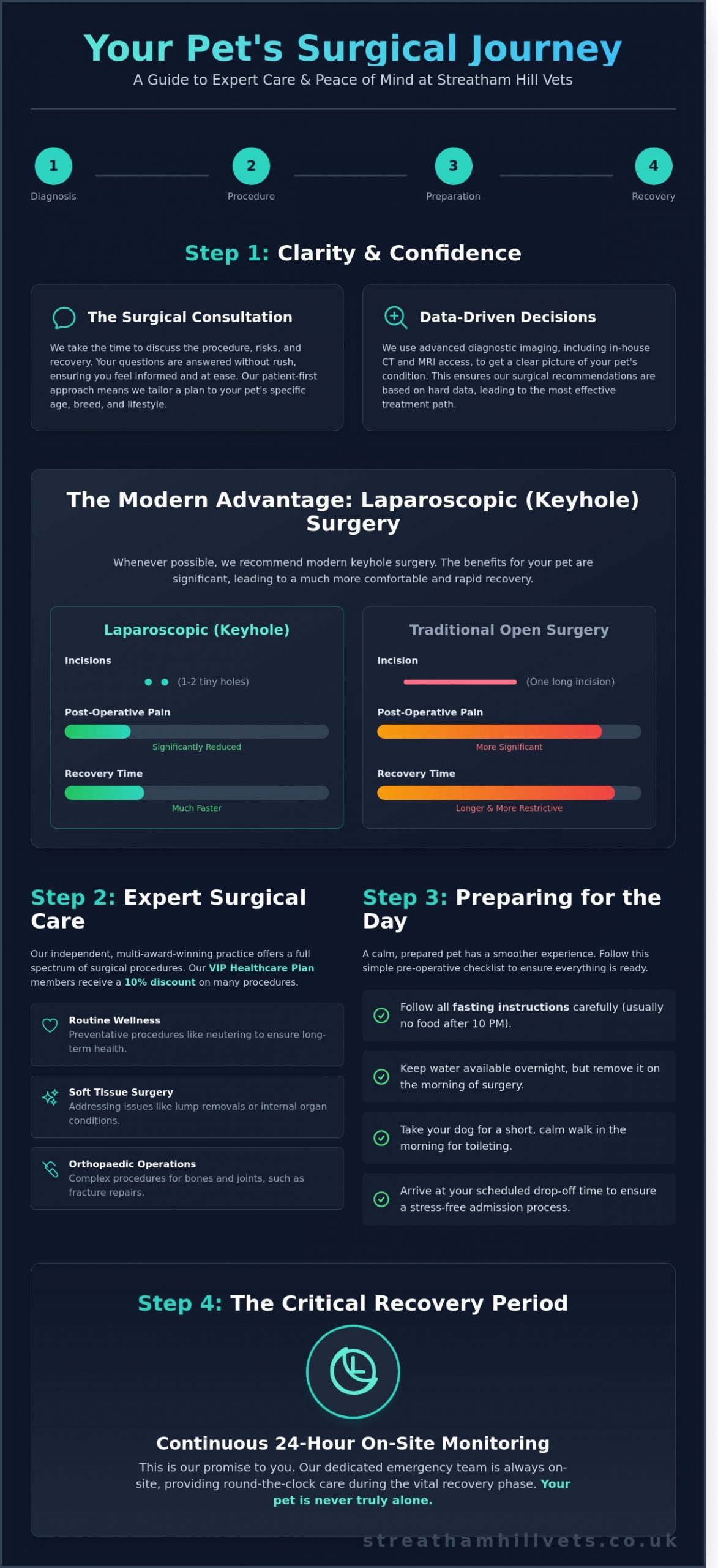
Laparoscopic or “keyhole” surgery represents a significant leap forward in pet care. By using specialized cameras and instruments through tiny incisions, we can perform complex procedures with minimal disruption to the body. This approach is often the preferred choice for owners in Clapham and Balham who want to minimize their pet’s post-operative discomfort. In our experience, we often see pets walking comfortably just hours after a keyhole procedure, which is a testament to the gentle nature of this technology.
The Benefits of Keyhole Surgery
We frequently recommend keyhole surgery for routine procedures like bitch spays. Instead of a large abdominal incision, we use two or three small ports. The high-definition camera provides our surgeons with up to ten times magnification of the internal organs. This increased precision allows for better visualization of blood vessels and tissues, leading to less bleeding and trauma during the veterinary operation.
The practical benefits for your pet are clear. There’s significantly reduced post-operative scarring and, crucially, a decreased need for those restrictive plastic collars that many pets find distressing. Most dogs return to their normal exercise routine within 5 to 7 days, compared to the 10 to 14 days typically required for traditional surgery. It’s a sophisticated way to ensure your pet’s experience is as stress-free as possible.
Traditional Surgical Excellence
While keyhole techniques are excellent, traditional surgery remains the gold standard for many situations. If we’re removing a large mass or performing an emergency procedure that requires a full view of the abdominal cavity, an open approach is often safer and more effective. Our surgeons are highly skilled in meticulous traditional techniques, ensuring that every incision is handled with the utmost care and precision.
Safety is our absolute priority, regardless of the method chosen. We utilize advanced anaesthetic monitoring equipment that tracks heart rate, blood pressure, and oxygen levels in real-time. If you’re feeling anxious about the process, reading up on preparing your pet for anesthesia can provide helpful context on the safety protocols we follow. As an independent practice with 24-hour emergency availability, we provide continuous care, meaning your pet is never left alone during their recovery in our hospital.
Whether choosing keyhole or traditional surgery, our South London team is here to guide you. We’ll discuss the pros and cons of each method during your consultation, helping you make an informed decision for your family member. For those on our VIP Health Plan, remember that your 10% discount applies to many aspects of surgical care, making these advanced options more accessible for every local pet owner.
Preparing Your Pet for Surgery: A South London Owner’s Checklist
We understand that the lead-up to a veterinary operation is often the most anxious time for owners in Streatham and Clapham. Our team works hard to ensure you feel supported through every step of this process. Preparation starts at home; a calm environment helps your pet arrive at the surgery in the best possible frame of mind. In our experience, we often see that a well-prepared owner leads to a more relaxed patient.
Financial planning is also a key part of preparation. If you’re a member of our VIP Health Plan, you’ll already benefit from a 10% discount on preventative care, ensuring your pet is in the best physical condition before they even reach our theatre. This plan helps manage the costs of routine health checks and parasite protocols, which are vital for a smooth recovery.
The Night Before the Operation
Standard fasting protocols are essential for the safety of dogs and cats undergoing anaesthesia. We ask that you withhold food from midnight the night before their procedure. Water should remain available at all times to prevent dehydration. Rabbits are a significant clinical exception; they must never be fasted because their digestive systems need to keep moving. Please bring a small bag of your rabbit’s favourite hay and leafy greens to encourage them to eat immediately after they wake up.
To help your pet feel settled, try to keep their evening routine as normal as possible. A gentle walk for dogs or some quiet play for cats can burn off nervous energy. Ensure they are clean and dry before arrival, as this helps us maintain a sterile surgical environment. If your pet seems particularly anxious on the morning of the appointment, please let us know so we can provide extra reassurance during the admission process.
Admission and Consent
Morning drop-offs usually take place between 8:00 am and 9:00 am at our Streatham surgery. You’ll meet with one of our experienced veterinary nurses to sign a formal consent form and discuss the day’s schedule. This is the perfect time to ask any last-minute questions. We strongly recommend pre-anaesthetic blood tests for all patients, especially those over seven years old. These tests allow us to check internal organ function before we administer any medication, providing an extra layer of clinical safety.
Once admitted, your pet will settle into our dedicated hospitalisation ward. To make their stay more comfortable, we suggest bringing the following items:
- A familiar-smelling blanket from home to provide comfort in their kennel.
- A favourite small toy that doesn’t pose a choking hazard.
- Any specific medications they are currently taking in their original packaging.
- A brief summary of their recent appetite and toilet habits.
Our team will provide you with a specific time to call for an update, usually in the early afternoon once the veterinary operation is complete and your pet is resting in recovery. If you’re based in Streatham, Clapham or Balham and would like advice, our team is always happy to help, including 24-hour emergency care if needed.
Post-Operative Care and 24-Hour Recovery in Streatham Hill
The first 24 hours following a veterinary operation represent the most vital window for a pet’s safety and comfort. During this period, the effects of anaesthesia wear off and the body begins its primary inflammatory response to surgery. In our experience, having a dedicated team on-site throughout the night isn’t just a luxury; it’s a clinical necessity for high-level surgical care. Our emergency 24-hour vetcare ensures that if your pet requires a multi-day stay, they’re supervised by qualified professionals every single minute. This level of continuous monitoring is a cornerstone of our status as a leading independent practice in South London.
Recovery in the Hospital
While your pet stays with us, our night vets and nurses follow strict pain management protocols. We don’t use a “one size fits all” approach. Instead, we tailor analgesia to the individual animal, monitoring heart rates and comfort levels closely. As an award-winning practice, we take pride in the fact that our patients are never left alone. This constant presence allows us to intervene immediately if a pet shows signs of discomfort or if their clinical parameters shift during the night. The peace of mind this provides to our clients is immeasurable, knowing their companion is in a safe, clinical environment rather than an empty building.
Returning Home to Streatham, Clapham, or Balham
When it’s time to head home, your pet’s environment needs to be carefully managed to prevent complications. We recommend creating a “recovery zone” on the ground floor to avoid stairs. This should be a quiet, warm area with non-slip flooring where they can rest undisturbed by other pets or children. Managing medication is a key part of this process; we’ll provide a clear schedule for all painkillers and antibiotics. Wound care is equally vital. You should check the surgical site twice daily for any redness, swelling, or discharge. If your pet seems excessively lethargic, refuses food for more than 24 hours, or if the wound looks angry, you must contact our out-of-hours team immediately.
We schedule follow-up health checks to ensure healing is progressing as expected. These appointments allow us to remove sutures and gradually increase exercise levels safely. Most pets require at least 10 to 14 days of restricted activity, which means lead-only walks for dogs and keeping cats indoors. If you’re based in Streatham, Clapham or Balham and would like advice, our team is always happy to help, including 24-hour emergency care if needed.
Ensuring a Safe and Comfortable Recovery for Your Companion
Deciding on a veterinary operation for your pet is a significant step; however, modern advancements in surgical techniques and diagnostic tools mean that most procedures are now safer and more efficient than ever before. Whether your pet requires a routine neutering or a more complex laparoscopic surgery, our focus remains on providing gentle, clinical excellence that prioritises their long-term health. We understand that the time surrounding surgery can be stressful for owners, which is why we offer the reassurance of on-site CT scanning and advanced diagnostics to ensure every detail is accounted for before we begin.
As a multi-award-winning independent practice, we’re proud to provide 24-hour emergency care with our own staff on-site 365 days a year. This means your pet is never left alone during their vital recovery period. If you’re based in Streatham, Clapham or Balham and would like advice, our team is always happy to help, including 24-hour emergency care if needed. You can book a surgical consultation at Streatham Hill Vets to discuss your pet’s needs with our experienced surgeons. We’re here to support you and your companion through every stage of their care, ensuring they return to their happy, healthy selves as quickly as possible.
Frequently Asked Questions
How long does a typical veterinary operation take for a dog or cat?
The duration of a veterinary operation depends entirely on the complexity of the procedure being performed. A routine cat neuter might take 15 minutes, whereas an intricate orthopaedic surgery at our Streatham hospital can last up to 3 hours. We always provide a specific time estimate during your morning admission appointment. Our team monitors your pet from the moment they arrive until they’re safely awake in our dedicated recovery ward.
Is anaesthesia safe for older pets or those with underlying conditions?
Modern anaesthesia is remarkably safe even for senior patients or those with chronic health conditions. We mitigate risks through pre-operative blood screens and tailored protocols designed by our clinical certificate holders. At Streatham Hill Vets, we use advanced monitoring equipment to track heart rate and oxygen levels throughout. In our experience, over 98% of senior pets handle anaesthesia exceptionally well when managed with this level of clinical precision.
Will my pet be in pain after their surgery?
Your pet’s comfort is our absolute priority and we use a multimodal approach to manage pain effectively. This involves a combination of local anaesthetics, nerve blocks, and post-operative medications to ensure a smooth recovery. We aim for a “zero pain” experience where possible. Most pets are back on their feet and eating within 4 hours of waking up. We’ll provide clear instructions and medications for you to continue this care at home.
Can I stay with my pet during their operation?
Owners cannot stay in the operating theatre because we must maintain a sterile, highly controlled environment for your pet’s safety. Our surgical suites are kept to human hospital standards to prevent infection and ensure our surgeons can focus entirely. However, we’ll call you as soon as the veterinary operation is complete and your companion is in recovery. You’re welcome to wait in our reception or head home to Balham while we work.
How much does a veterinary operation cost in London?
Surgical costs in London vary based on the procedure and equipment required for the case. A standard minor procedure may range from £250 to £600, while complex specialist surgeries involving our CT scanner can exceed £3,500. We provide transparent, written estimates before any work begins. Members of our Healthcare Plan receive a 10% discount on these fees, helping to make our independent, award-winning care more accessible for local families in South London.
What happens if there is an emergency during the night after surgery?
We provide 24-hour emergency care on-site at Streatham Hill Vets, so help is always available if you’re worried overnight. Unlike many practices that outsource their out-of-hours care to distant clinics, our own team is here for you. If you notice any unusual signs after surgery, you can call our emergency line at any hour. This continuity of care ensures your pet’s full medical history is immediately available to the duty vet.
How soon can my pet return to normal exercise after a keyhole operation?
Pets undergoing laparoscopic or “keyhole” surgery typically return to normal activity much faster than those with traditional incisions. You can usually start short lead walks after 48 hours. Most dogs are cleared for full, off-lead exercise within 7 to 10 days of the procedure. Because the wounds are only 5mm to 10mm in size, there’s significantly less tissue trauma, meaning your pet will feel like their usual self much sooner.
Do I need to fast my rabbit before their operation?
You must never fast a rabbit before surgery because their digestive systems need to stay in constant motion to stay healthy. Unlike dogs and cats, rabbits cannot vomit, so there’s no risk of aspiration under anaesthesia. Please bring a small bag of their favourite hay or leafy greens to the clinic. We encourage them to eat immediately upon waking to prevent gastrointestinal stasis, which is a common concern in small herbivore recovery.