
At Streatham Hill Vets, we recommend neutering for most pet rabbits that are not intended for breeding. Rabbit neutering is not just about preventing unwanted litters. It is also an important part of preventive healthcare and can make a real difference to your rabbit’s long-term health, behaviour and quality of life.
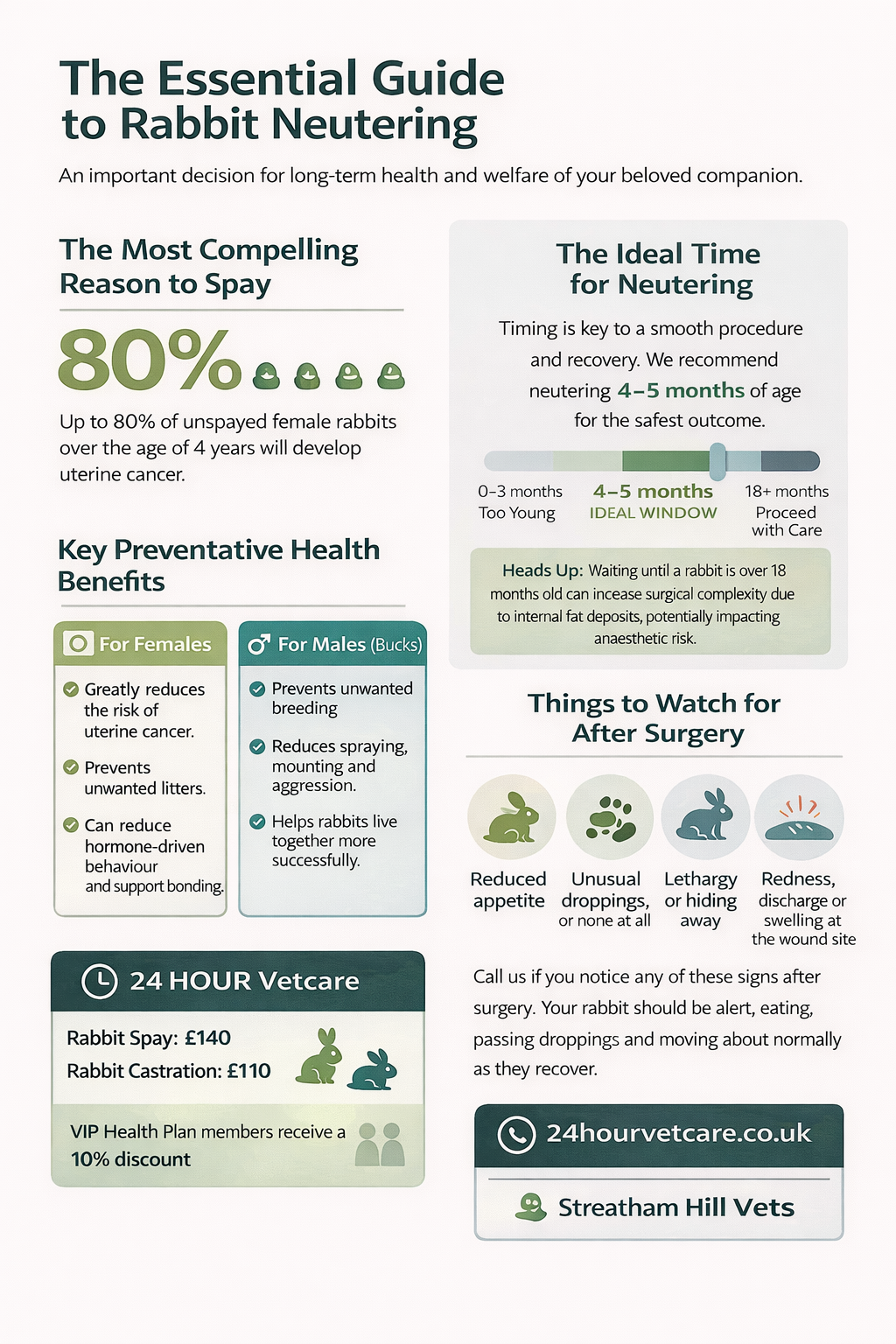
For female rabbits in particular, spaying is strongly recommended because of the high risk of uterine cancer if they are left unspayed. Spaying removes the uterus and ovaries, preventing this risk as well as other uterine disease. For male rabbits, castration helps prevent breeding and may also reduce hormone-driven behaviours such as spraying, mounting and territorial aggression.
We see rabbits from Streatham Hill, Balham, Brixton, Clapham, Tooting and the surrounding South London area, and we know owners often want clear, practical advice before making a decision.
Why do we recommend neutering rabbits?
There are several important reasons to neuter a rabbit.
For female rabbits, the main health benefit is preventing uterine cancer, which is very common in unspayed does as they get older. This is one of the most important reasons to discuss neutering early rather than waiting until later life.
For male rabbits, castration prevents unwanted breeding and often helps reduce hormone-related behaviours such as urine spraying, mounting and aggression.
Neutering can also make it easier to bond rabbits successfully and helps many rabbits live more happily together.
What is the difference between a rabbit spay and a rabbit castration?
A spay is the neutering procedure for a female rabbit and involves removal of the ovaries and uterus.
A castration is the neutering procedure for a male rabbit and involves removal of the testicles.
What is the ideal age to neuter a rabbit?
In most pet rabbits, neutering is usually planned at around 4 to 6 months of age, although the exact timing depends on sex, breed and development.
Male rabbits can become fertile from quite a young age, and female rabbits can also reproduce early, so it is sensible to plan ahead rather than wait until maturity is obvious. If you have a mixed-sex pair or littermates growing up together, this is especially important.
We can advise you on the right timing for your rabbit at a pre-operative consultation.
Do rabbits need to be starved before surgery?
No. Rabbits should not usually be starved before neutering.
Their digestive system needs to keep moving normally, so fasting them in the same way as a dog or cat is not appropriate. We will give you clear instructions before the procedure, but in most cases rabbits should continue eating as normal until admission.
Are there risks with rabbit anaesthesia?
As with any operation, there are always some risks with anaesthesia and surgery.
In rabbits, the anaesthetic risk is generally a little higher than in dogs and cats. Rabbits are more sensitive to stress, and they can be prone to slowing down in their recovery if they do not eat well afterwards. However, rabbit neutering is still a routine and worthwhile procedure in the vast majority of cases, particularly given the long-term health and welfare benefits.
For females, this includes preventing uterine cancer later in life. For both males and females, it also helps avoid unwanted litters and can improve behaviour and compatibility with other rabbits.
What happens after surgery?
Rabbits usually go home with pain relief and full aftercare advice.
We normally recommend a post-operative check 2 to 3 days after surgery, and a further check at around 10 to 14 days, so we can monitor healing and make sure recovery is progressing as expected.
One of the most important things to monitor after rabbit neutering is appetite. If a rabbit does not eat properly after surgery, their gut can slow down and they can become unwell quite quickly. Once your rabbit is home, you should monitor eating, droppings and general behaviour closely, and check the wound at least twice daily.
Please contact us promptly if your rabbit is not eating, seems unusually quiet, or if you are concerned about pain, swelling or discharge from the wound.
How long is a male rabbit still fertile after castration?
This is an important point for owners of mixed-sex rabbits.
Male rabbits are not sterile immediately after castration and may remain fertile for up to 6 weeks afterwards. If you have an unspayed female rabbit at home, we will advise you on how long they should be kept apart after surgery.
Rabbit neutering costs
Rabbit Spay: £140
Rabbit Castration: £110
VIP Health Plan members receive a 10% discount.
Book a rabbit neutering consultation in Streatham Hill
If you are thinking about rabbit neutering, we can see your rabbit for a consultation, advise you on timing, explain the procedure and talk you through recovery, pain relief and post-operative checks.
If you have any concerns after surgery, our 24 Hour Vetcare service means help is available when you need it.